

Hanging a cabinet on a block wall: which plugs, and how
12 בJuly 2026
What are wall plugs made of, and why does it matter?
12 בJuly 2026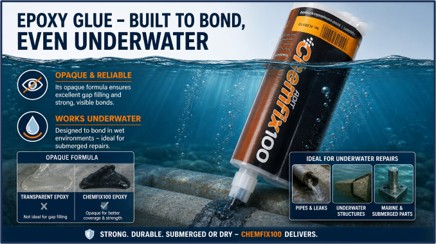
The Watertightness of Chemical Adhesives and Their Use in Underwater Applications
Advanced chemical adhesives — epoxy adhesives foremost among them — are considered one of the most reliable material groups in modern industry. Thanks to their watertightness, strong bonding and chemical durability, they have become the preferred solution in underwater environments, the shipping industry, marine engineering and many other critical applications.
In short
Epoxy adhesives form a dense, three-dimensional polymer network that is watertight, bonds strongly to metal, glass, concrete and plastic, and resists salts, weak acids and prolonged seawater exposure. Different sealants suit different jobs: epoxy and polyurethane for permanent underwater joints, polysulfide and polyether/hybrid for flexible joints that may need removing, and silicone and butyl only above the waterline. For structural underwater anchoring — port quays, fenders and mooring systems — a purpose-made adhesive such as Adit Chemfix 100 transfers loads with no expansion stress and fully seals the hole against seawater.
What is epoxy adhesive?
Epoxy adhesive is a two-part polymeric material, made up of a resin and a hardener. When the two components are mixed, a chemical reaction (polymerisation) takes place that creates a hard, stable and durable material.
The most common epoxy resins are made from a mixture of epichlorohydrin and bisphenol A, and the global epoxy industry is estimated at an annual turnover of about 15 billion dollars.
Early attempts to develop epoxy resins began as far back as 1927 in the United States, but the first commercial success came in the 1930s — thanks to Dr Pierre Castan (Switzerland) and Dr Sylvan Greenlee (USA). Today, epoxy products are sold in DIY stores and are also used for designer wooden tables, crack repairs, and even as base materials in the automotive and aerospace industries.
Types of chemical adhesives and sealants
Epoxy
A two-part adhesive with very high strength and excellent mechanical and chemical durability. It cures to a rigid, resistant material. Suitable for dowel and chemical anchoring, structure repair, bridges, pipes and components requiring maximum strength. Flexible versions exist that are also resistant to moisture.
Limitations: long curing time; sensitive to an inaccurate mix ratio; hard to remove after curing.
Polyurethane
Very strong sealing (about 700 psi), suitable for use above and below the waterline. UV resistant. Used for hull-to-deck joints, keel connections and through-hull fittings. Well-known products: 3M 5200, Sikaflex 291/292.
Limitations: very hard to remove; not suitable for many plastic types (ABS, Lexan).
Polysulfide
A flexible synthetic rubber, resistant to UV, oil and fuel. Excellent for sealing wire grooves, teak decking and wood joints. Allows a degree of movement. Can be painted.
Limitations: must not be used with plastics (Plexiglas, Lexan, ABS, PVC) — it will cause them to crack.
Silicone
Very flexible, resistant to heat and UV, suitable for plastics. Excellent for sealing windows, hatches and various metal guards. A lower bond strength; environmentally friendly. Example: West Marine Multi-Caulk, 3M 4000UV.
Limitations: may harm some plastics.
Polyether / hybrid (SMP)
Combines the advantages of silicone and polyurethane. Fast cure, low odour, high adhesion, UV resistant and paintable. Suitable above and below the waterline.
Butyl
A flexible sealing material with almost no bonding strength. Suitable for bedding deck equipment, screw holes and sealing openings. Stays flexible over time and is easy to disassemble.
Limitations: not suitable for prolonged exposure to water.
Quick comparison table — types of chemical adhesives
| Adhesive type | Bond strength | Underwater | Plastics | Removable | UV resistance |
|---|---|---|---|---|---|
| Epoxy | Very high | Yes | Partial | No | Medium |
| Polyurethane | Very high (~700 psi) | Yes | No (most types) | Very hard | Yes |
| Polysulfide | Medium-high | Yes | No | Relatively | Yes |
| Silicone | Low | No | Yes | Yes | Yes |
| Polyether hybrid | Medium-high | Yes | Partial | Relatively | Yes |
| Butyl | Low | No (long-term) | Yes | Yes | Medium |
The watertightness of epoxy adhesives — how does it work?
One of the most notable properties of epoxy adhesives is their high impermeability to liquids and gases. This property stems from several factors:
- A dense molecular structure: the polymer network formed after curing barely allows water or other substances to pass through.
- Excellent adhesion to surfaces: the epoxy forms a strong bond with a range of materials — metals, glass, concrete and plastic — and prevents the formation of cracks through which liquids could penetrate.
- High chemical resistance: epoxy adhesives resist salts, weak acids and many chemicals, which reinforces the sealing ability over time.
- Water resistance: even under prolonged exposure to salt water, the adhesive keeps its integrity and does not break down.
- Mechanical resistance: the adhesive can withstand high pressures, underwater conditions and temperature changes.
Detailed sealing notes by adhesive type
Epoxy — sealing notes
Epoxy adhesives provide a rigid, final seal. After curing, they form a hard layer that cannot be disassembled. Not recommended for sealing through-hull fittings that may need removing in future — access afterwards could damage the boat’s hull. A flexible epoxy (such as G-Flex) has better resistance to wet surfaces and thermal expansion.
Polyurethane — sealing notes
Polyurethanes provide a very strong seal, suitable for permanent joints below the waterline. A product like 3M 5200 is known for its enormous strength — there is documentation of keels held with it. Use it only where you do not expect to disassemble the joint.
Polysulfide — sealing notes
Polysulfide provides a flexible seal that allows slight movement, which suits deck grooves and wood edges. It creates a reliable seal over time, but note that products like Life-Calk may take 10–20 days for full cure. Importantly, do not use it to seal plastic parts — it will cause them to crack.
Silicone — sealing notes
Silicone creates an excellent flexible seal above the waterline — ideal for windows, hatches and connection points between dissimilar metals (to prevent galvanic corrosion). But under prolonged water exposure, silicone may swell and lose adhesion — so it must not be used for permanent underwater sealing. The surface must be cleaned thoroughly, because silicone residue will prevent future bonding.
Polyether / hybrid — sealing notes
Hybrid materials are the most balanced choice — usable above and below the waterline, UV resistant, paintable, and relatively easy to disassemble. Products like 3M 4000UV are also safe for plastics. Their cure is faster than polysulfide.
Uses in underwater environments
Thanks to the unique properties of epoxy and other chemical adhesives, they are widely used in underwater environments where especially high durability is required:
Underwater construction and anchoring (with adhesives suited to underwater work, such as Adit Chemfix 100)
Advanced structural resins — above all an upgraded pure epoxy (Pure Epoxy 3:1) such as Adit Chemfix 100 — are a cornerstone of modern marine engineering. These materials are designed and approved for work in fully submerged conditions. They develop very high bond strength to underwater concrete and rock, displace the water out of the borehole as they are injected, and resist abrasion, chlorides and seawater sulphates over the long term.
Underwater anchoring systems protecting quays from ship loads and wear
Port quays and marine infrastructure are constantly exposed to enormous dynamic loads, shocks and mechanical and chemical wear caused by ships mooring, strong sea currents and light impacts as vessels approach the quay. To prevent the wear of the structures and the quay body, energy-absorbing bumper systems (fenders) and dedicated mooring systems are installed, connected directly to the underwater sea walls. Anchoring these heavy steel structures requires inserting high-capacity threaded rods and anchor bolts deep into the concrete under water. Injecting Chemfix 100 ensures optimal load transfer with no expansion stresses in the concrete (unlike mechanical anchors), and completely seals the hole against seawater ingress, thereby preventing accelerated corrosion of the anchor and of the quay’s internal reinforcement.
Measurement and monitoring systems in an underwater environment
Preventive maintenance, risk management and structural control of port infrastructure call for up-to-date digital measurement and monitoring — Structural Health Monitoring (SHM). These systems use hydro-acoustic sensors, strain gauges and tiltmeters mounted directly on structural elements below the waterline or on the seabed. The sensors have to be held completely rigid and stable to give accurate, reliable readings over time. The instrument mounts are fixed with Chemfix 100, which gives absolute geometric stability, prevents microscopic movement under the currents, and provides an insulating layer that protects the electronics from galvanic corrosion currents.
Port expansion by underwater dowelling ahead of a new pour
In port development and expansion — thickening existing quays, extending finger piers or building new sea walls — the central engineering challenge is achieving full structural continuity, monolithic behaviour, between the existing old concrete and the new concrete poured under water. The accepted and safest engineering route to that connection is underwater dowelling with starter bars. The process is: drill under water into the existing concrete, clean the flooded hole carefully in line with the product’s ETA instructions, inject the pure epoxy resin Adit Chemfix 100, and insert the reinforcing bars. The pure resin displaces the water, envelops the bar and achieves maximum pull-out strength, so that full shear and tensile stresses transfer from the new concrete into the existing structure and the extension stands up to the forces of nature.
Repair of underwater structures
Epoxy adhesives are used to repair cracks and breaks in structures such as bridges, quays, dams and underwater pipes. Their ability to be applied in wet environments too (in special versions such as G-Flex) makes them indispensable in maintaining critical infrastructure.
The shipping industry
In the marine field, epoxy and polyurethane are used to bond and seal parts of vessels, including hull repair, joining components and sealing water ingress. For through-hull fittings and hull-to-deck joints, a polyurethane such as 3M 5200 is recommended for its phenomenal strength and proven durability.
Piping and conveyance systems
In underground or underwater water and sewage systems, epoxy and polyurethane adhesives are used to seal connections and prevent leaks, especially in hard-to-reach places.
Underwater electronics
In electronic systems operating under water (such as sensors or cameras), epoxy is used to coat and seal sensitive components, to protect them from water ingress and corrosion. Flexible versions of the epoxy suit components subject to vibration or movement.
Diving and marine research applications
Research equipment and diving gear require materials resistant to high pressures and salt water. Epoxy adhesives are used to bond and seal components in this equipment.
Challenges and limitations
Despite the many advantages of chemical adhesives, there are also several challenges to take into account:
- Variable curing time: sometimes unsuitable for situations requiring a very fast repair. Polysulfide, for example, may take up to 20 days for full cure.
- Sensitivity to an inaccurate mix ratio: a two-part epoxy requires a completely accurate mix of resin and hardener — a deviation can cause only partial curing.
- Some drop in mechanical properties at extreme temperatures: even the best adhesives may lose strength at very high or very low temperatures.
- Material compatibility: polysulfide and polyurethane may harm plastics of various types. Always check compatibility before applying.
- Difficulty of removal: strong materials such as 3M 5200 and rigid epoxy are almost impossible to remove without damaging the base material.
- Odour and safety: some adhesives, especially epoxy and two-part materials, release fumes that must be worked with only in adequate ventilation.
Common questions (FAQ) — chemical adhesives and underwater sealing
What is the difference between an epoxy adhesive and a polyurethane sealant?
Epoxy adhesive is mainly a bonding material intended for a strong, permanent connection between two pieces of material. Polyurethane is usually a combined sealant and adhesive — strong at creating a bond with the surface, but more flexible than rigid epoxy. For permanent underwater joints both are excellent, but for joints that may need disassembling in future, a medium-strength polyurethane (such as 3M 4200) is preferable to epoxy.
Why must silicone not be used below the waterline?
Silicone is an excellent sealant above the waterline, but under prolonged water exposure it may swell, soften and lose its adhesion to the surface. As a result, underwater joints with silicone may fail and allow water ingress. For joints below the waterline, always choose polyurethane, polysulfide or polyether/hybrid.
How long do chemical adhesives take to cure?
Curing time varies greatly between types. Ordinary epoxy cures within a few hours (initial cure), but full cure may take 24–72 hours. 3M 5200 may take two weeks for full cure. Polysulfide such as Life-Calk: 10–20 days. “Fast Cure” products are significantly faster but sometimes at reduced strength. Always wait for full cure before loading the joint.
What is the difference between epoxy and MMA (methyl methacrylate)?
MMA (Methyl Methacrylate) is a different family of strong two-part adhesives. A common brand is Plexus. MMA offers fast cure, strong adhesion to a wide range of surfaces (including many plastics), and flexibility after curing. It is a good alternative to epoxy when a faster cure is needed or when epoxy is unsuitable for the surface type.
Is polysulfide suitable for sealing through-hull fittings?
Yes, polysulfide is suitable, but it is not the optimal choice for high-strength permanent underwater joints. For through-hull fittings, a polyurethane (such as Sikaflex 292) is the choice preferred by marine professionals. The simple rule: for joints you will need to disassemble in future — polysulfide; for permanent joints — polyurethane.
Can chemical sealants be painted?
It depends on the material type. Polysulfide and polyether hybrid can be painted after full cure. Polyurethane can be painted, but check compatibility with the paint. Silicone cannot be painted (the paint will not adhere). Epoxy can be painted after a light sanding.
What are the safety risks of using chemical adhesives?
Two-part adhesives (epoxy and MMA) release fumes during mixing and curing — work with gloves, eye protection and adequate ventilation. Many amines (hardeners) irritate the skin and may cause an allergic sensitivity. Polyurethane contains isocyanates that must be handled carefully in a closed environment. Always read the safety data sheet (MSDS/SDS) before use.
How do you remove old chemical adhesive without damaging the surface?
For silicone — scrape with a sharp blade, then clean with acetone or white vinegar. For polysulfide — a commercial remover such as Anti-Bond 2015 is effective. For polyurethane (5200) — very hard; the same Anti-Bond remover may help, but a careful mechanical scraper is sometimes needed. For rigid epoxy — usually requires mechanical sanding or careful heating. Always clean the surface fully before a new application.
Summary
Epoxy adhesives offer an exceptional combination of strength, durability and watertightness that makes them a leading solution in underwater applications. Their ability to work in harsh conditions, including prolonged exposure to water and high pressures, secures their place as an essential tool in many industries — from civil engineering to advanced marine research.
Sources
- ADIT Chemfix 100 underwater anchoring technical data.
- Marine adhesives and sealants reference material (epoxy, polyurethane, polysulfide, silicone, polyether/hybrid, butyl) and manufacturer product data (3M, Sikaflex, West Marine).