

The Watertightness of Chemical Adhesives and Their Use in Underwater Applications
12 בJuly 2026
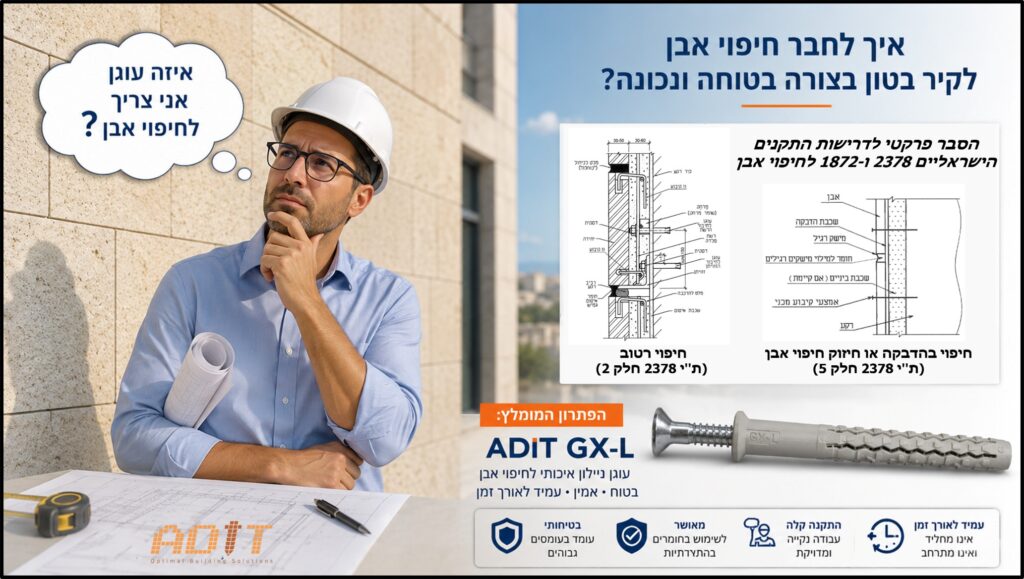
Which is the most appropriate anchor or nylon plug? A Guide to the Choice of anchoring
12 בJuly 2026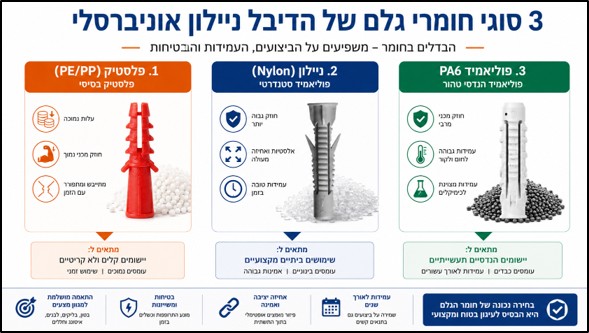
What Are Wall Plugs Made Of, and What Is the Advantage of Each Material?
Wall plugs (wall anchors) are small but vital components in construction, infrastructure and professional installation. They let screws be connected to walls and substrates of various materials in a stable, safe and lasting way — and one of the biggest factors in a plug’s quality, load capacity and durability is the raw material it is made from.
In short
The plastic anchoring world splits into three categories by polymer quality: cheap general plastic (PE/PP) that dries out and creeps under load; standard nylon (a polyamide) that offers good elasticity and mechanical strength; and pure engineering polyamide (PA6/PA66), used in top-tier plugs such as the Adit GX-L, that delivers extreme load capacity, excellent creep resistance, long service life and chemical durability. In engineering projects, the failure of a single plug can cause huge damage and even danger to life — so the raw material is not a corner to cut.
What materials are wall plugs made of?
The range of plugs on the market is wide, but the plastic anchoring world can be divided into three main categories based on the polymer’s quality and chemical composition:
1. General plastic (PE / PP)
Simple, cheap plugs of polyethylene or polypropylene. Mechanically weak, they tend to dry out over the years, are sensitive to deformation under a constant load (creep), and are unsuitable for professional applications.
- Advantages: especially low production cost, light weight and natural resistance to moisture.
- Disadvantages: low mechanical strength, a tendency to dry out and crumble after a few years, and high sensitivity to the “creep” phenomenon under a constant load.
2. Nylon
Nylon is a popular trade name for a group of polymers from the polyamide family. A “nylon plug” is considered the quality standard required for reliable installations.
- Mechanical strength: significantly higher than ordinary plastic, allowing medium weights to be hung safely.
- Elasticity: allows a gradual expansion and a strong lock against cavities inside the substrate.
- Wear resistance: good resistance while the screw is driven, with no destruction of the internal thread.
3. Pure engineering polyamide (Polyamide 6 / 66)
The highest-level professional engineering plugs (such as the Adit GX-L) use advanced, pure polyamide types, with no added recycled materials that harm performance.
The structural advantages of professional polyamide plugs
- Extreme load capacity: a high load-bearing ability that allows the design of complex connections in concrete, Ytong and hollow blocks.
- Material creep resistance: the polyamide maintains its expansion pressure inside the hole for many years with no loosening.
- Exceptional thermal resistance: mechanical stability from deep freeze to extreme heat.
- Ageing and chemical resistance: a material completely immune to rot, mould, oils and corrosive environments.
Engineering comparison table — plastic, nylon and polyamide
| Technical parameter | Basic plastic (PE / PP) | Standard nylon | Engineering polyamide (PA6 / PA66) |
|---|---|---|---|
| Mechanical & pull-out strength | Very low | Medium to high | Very high (heavy loads) |
| Long-term durability (ageing) | Low (dries and becomes brittle) | Good | Excellent (long service life) |
| Durability under constant load (creep) | Poor (gradually loses grip) | Relatively good | Excellent (continuous expansion pressure) |
| Suitability for complex substrates | Unsuitable | Partially suitable | Perfect (Ytong, hollow and solid) |
Why you must not compromise on raw-material quality
In engineering and industrial projects, the failure of a single plug can lead to enormous economic damage and even danger to life. Construction sites are characterised by harsh environmental conditions including high humidity, sun exposure, chemicals and constant dynamic loads (such as winds or vibrations). Simple plastic plugs cannot cope with these stresses, and they tend to pull out or shear under pressure.
ADIT markets only standard European anchoring solutions. Working with advanced polyamide plugs, such as the Adit GX-L series, ensures an optimal distribution of stresses inside the drill hole, compliance with the engineering design specifications, and full peace of mind for inspectors and contractors in the field.
Common questions (FAQ)
How can you tell cheap plastic from professional polyamide by eye?
Simple plastic plugs tend to look glossy and feel soft. Bend one hard and it will usually whiten at the bend point, or snap. Polyamide and engineering nylon plugs generally have a matt finish, are stiffer and more substantial, and take extreme deformation without breaking.
What is the difference between a cheap plastic plug and a nylon plug?
Cheap plastic (polyethylene/polypropylene) quickly loses its flexibility, dries out and creeps under a constant load. Nylon (a polyamide) is significantly stronger mechanically, elastic enough to lock firmly against cavities, and durable for many years without drying out.
What happens to a plastic plug under a constant load?
Basic plastic (PE/PP) suffers from material creep. Immediately after installation it may feel solid, but under a constant load the plastic stretches and its molecular structure changes. It loses its internal expansion pressure, and eventually pulls out of the wall together with whatever it was carrying.
What does PA6 / PA66 mean?
PA6 and PA66 are pure engineering-grade polyamides used in the highest-quality professional plugs (such as the Adit GX-L). They offer extreme load capacity, excellent creep resistance, wide thermal stability and chemical durability, with no recycled additives that would harm performance.
Why not just use the cheapest plug?
Because a single plug failure can cause huge damage or danger. Cheap plastic plugs cannot handle the moisture, sun, chemicals and dynamic loads of a real construction site, and tend to pull out or shear under pressure. A quality polyamide plug distributes stresses optimally and holds for the structure’s life.
Is a polyamide plug suitable for hollow block or Ytong?
Yes. But beyond the raw material, the geometry of the plug is critical. An advanced polyamide plug such as the GX-L is engineered either to expand in several directions in solid concrete, or to fold over and form a locked mechanical key behind the inner face of a hollow block.
Does the raw material affect which screw can be used?
Yes. Engineering polyamide (PA6) has a high internal resistance to wear and tearing, so it can accept screws with different thread forms — chipboard, wood or universal screws — without the thread stripping. Simple plastic plugs are easily destroyed and ground out from the inside if the screw type is not a perfect match.
Sources
- ADIT GX-L engineering polyamide plug technical data.
- General material-science guidance on plug polymers (PE/PP vs nylon vs PA6/PA66; creep, ageing, chemical resistance).