
A Dangerous Deception in the Adhesive Market: Selling Epoxy-Acrylate as Epoxy
12 בJuly 2026
Hanging a cabinet on a block wall: which plugs, and how
12 בJuly 2026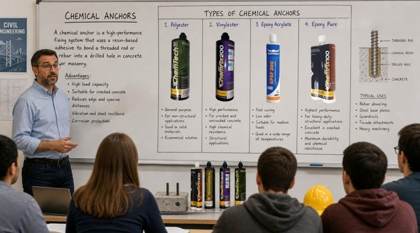
Chemical anchors are among the most widely used tools in civil engineering. They connect threaded rods, rebar dowels and other components into concrete, blocks and stone, relying on a strong chemical bond between the adhesive and the wall of the hole. But not all adhesives are equal: each chemical family behaves differently in bond strength, working time, heat resistance, performance in cracked concrete, and seismic compliance.
The guiding principle. Choosing the right adhesive is a critical engineering decision. The “cheapest” adhesive can turn out to be the most expensive choice once engineering liability, reduced resistance and approval limits are taken into account.
This article examines four principal families: pure epoxy (Chemfix 100), vinylester hybrid (Chemfix 200), styrene-free epoxy acrylate (Elram V200), and polyester (CT50Pro / PESF TOP — the same adhesive under different labels). All resistance figures come from Adit’s technical datasheets, to EN 1992-4:2018.
Seismic approval — the Israeli requirement
Critical for design in Israel
- Category C1 — non-structural design: light steelwork and infrastructure.
- Category C2 — structural design: load-bearing connections and primary structure.
An adhesive without a seismic approval is not admissible on most Israeli projects.
Two kinds of approval must be distinguished. The ATR (threaded rod) approval — ETA-19/0705 for Chemfix 100, ETA-18/0797 for Chemfix 200 — carries the C1 and C2 categories. The rebar approval is entirely separate, issued under TR023 — ETA-18/1157 for Chemfix 100, ETA-18/0798 for Chemfix 200 — and is a blanket seismic design approval without C1/C2 categories, since those belong to the ATR standard alone. CT50Pro/PESF and Elram V200 hold no seismic approval at all, for either.
The four chemical families
① Pure epoxy — Chemfix 100
Two-component epoxy resin, 1:1. The highest bond strength of the four; approved for diamond drilling (DD) in cracked and uncracked concrete. Working time 22–70 minutes, which matters in deep holes. C1 + C2 for both ATR and rebar. 100-year service life.
② Vinylester hybrid — Chemfix 200
Vinylester with epoxy. High strength with fast cure, up to 120 °C. Diamond drilling approved. C1 + C2 for ATR and rebar. Holds ICC-ES ESR-4366 and a LEED contribution.
③ Styrene-free epoxy acrylate — Elram V200
Fast cure, low odour. No seismic approval. Hammer drilling and compressed air only — not diamond drilling. In cracked concrete: M10–M24 for ATR only.
④ Polyester — CT50Pro / PESF
The most economical, curing in 3–40 minutes. CT50Pro and PESF are the same adhesive (Chemfix Products Ltd). No seismic approval, no cracked concrete, not for diamond drilling.
General characteristics compared
| Property | Chemfix 100 pure epoxy | Chemfix 200 vinylester hybrid | Elram V200 epoxy acrylate | CT50Pro / PESF polyester |
|---|---|---|---|---|
| Mixing ratio | 1:1 | 10:1 | 10:1 | 10:1 |
| Working time (25 °C) | 22 min | ~8 min | 7.5 min | 5 min |
| Cure time (25 °C) | 17 h | ~3 h | 85 min | 30 min |
| Heat resistance | 80 °C continuous / 120 °C short | 120 °C continuous | 80 °C continuous | 40 °C continuous |
| Wet or flooded hole | yes — full | yes — full | yes (partial) | yes |
| Diamond drilling (DD) | ✔ ETA — cracked + uncracked | ✔ ETA — cracked + uncracked | ✘ not approved (hammer only) | ✘ not recommended |
| Seismic C1 + C2 — ATR | ✔ C1+C2 (ETA-19/0705) | ✔ C1+C2 (ETA-18/0797) | ✘ none | ✘ none |
| Seismic — rebar | ✔ blanket TR023 approval (ETA-18/1157) | ✔ blanket TR023 approval (ETA-18/0798) | ✘ none | ✘ none |
| Cracked concrete | ✔ yes | ✔ yes | M10–M24 only (ATR) | ✘ no |
| Fire resistance | R120 | R120 | per ETA | — |
| LEED / environmental | A+ VOC, WRAS, LEED 2021 | A+ VOC, LEED 2014 | A+ VOC | A+ VOC |
| ICC-ES (USA) | — | ESR-4366 | — | — |
| Service life | 100 years | 50 years | 50 years | 50 years |
| Cost per 100 ml | high | medium-low | medium-high | lowest |
Critical note — large diameters and deep embedments. Above M20/Ø20, or at embedments deeper than 200 mm, an adhesive with a long working time is strongly preferred. Chemfix 100, at 22 minutes at 25 °C, is the most suitable. Fast-curing adhesives can begin to gel before the rod has been pushed to the required depth.
Resistance compared — threaded rods (ATR)
Design resistances Nrd and Vrd for grade 8.8 threaded rod in C30 concrete, single anchor, at standard embedment.
Nrd and Vrd (kN) — threaded rod, grade 8.8 steel, C30 concrete
| Rod size | Concrete | Chemfix 100 | Chemfix 200 | Elram V200 | CT50Pro / PESF | ||||
|---|---|---|---|---|---|---|---|---|---|
| Nrd | Vrd | Nrd | Vrd | Nrd | Vrd | Nrd | Vrd | ||
| M8 | uncracked | 19.5 | 12.0 | 18.5 | 12.0 | 9.8 | 12.0 | 9.9 | 11.7 |
| cracked | 10.7 | 12.0 | 8.2 | 12.0 | not approved | not approved | |||
| M10 | uncracked | 30.0 | 18.6 | 23.3 | 18.4 | 13.3 | 18.4 | 12.4 | 18.6 |
| cracked | 14.2 | 18.6 | 10.2 | 18.4 | 6.3 | — | not approved | ||
| M12 | uncracked | 44.0 | 27.2 | 34.1 | 27.2 | 19.1 | 27.2 | 17.1 | 27.0 |
| cracked | 17.1 | 27.0 | 17.6 | 27.2 | 9.0 | — | not approved | ||
| M16 | uncracked | 56.1 | 50.4 | 51.6 | 50.4 | 32.2 | 50.4 | 24.6 | 50.2 |
| cracked | 27.8 | 50.2 | 26.7 | 50.4 | 16.1 | — | not approved | ||
| M20 | uncracked | 89.0 | 78.4 | 87.8 | 78.4 | 47.5 | 78.4 | 38.9 | 78.4 |
| cracked | 50.4 | 78.4 | 45.4 | 78.4 | 22.3 | — | not approved | ||
| M24 | uncracked | 122.2 | 113.0 | 116.6 | 112.8 | 64.3 | 112.8 | 48.6 | 113.0 |
| cracked | 74.6 | 113.0 | 67.3 | 112.8 | 32.2 | — | not approved | ||
| M27 | uncracked | 149.3 | 147.2 | 138.4 | 147.2 | 56.7 | — | — | |
| cracked | 95.9 | 146.8 | 98.1 | 147.2 | not approved | not approved | |||
| M30 | uncracked | 188.2 | 179.5 | 164.5 | 179.2 | 59.2 | — | — | |
| cracked | 124.3 | 179.5 | 127.1 | 179.2 | not approved | not approved | |||
| M33 | uncracked | 208.7 | 222.1 | — | — | — | |||
| cracked | 146.1 | 222.1 | — | not approved | not approved | ||||
| M36 | uncracked | 251.8 | 261.4 | — | — | — | |||
| cracked | 176.3 | 261.4 | — | not approved | not approved | ||||
Seismic approvals — ATR
| Parameter | Chemfix 100 | Chemfix 200 | Elram V200 | CT50Pro / PESF |
|---|---|---|---|---|
| Principal ETA — ATR | ETA-19/0705 | ETA-18/0797 | ETA-14/0104 (no seismic approval) | ETA-15/0008 (no seismic approval) |
| Seismic C1 (non-structural) | ✔ all diameters | ✔ all diameters | ✘ none | ✘ none |
| Seismic C2 (structural + cracked) | ✔ M12–M24 | ✔ M12–M20 | ✘ none | ✘ none |
Threaded rods — the summary
Chemfix 100 (pure epoxy)
best suited to M20 and above, deep embedments, C2, cracked concrete, diamond drilling, and M33–M36. Its Nrd is significantly higher.
Chemfix 200 (vinylester hybrid)
best for C1 + C2 up to M27, fast cure, 120 °C service, diamond drilling. Its Nrd is close to the Chemfix 100 across M12–M24.
Elram V200 (epoxy acrylate)
only where there is no seismic requirement and no diamond drilling. Relatively low Nrd; cracked concrete M10–M24. Not permitted for C1 or C2.
CT50Pro / PESF (polyester)
uncracked concrete, no seismic capability, hammer drilling, M8–M24. Not admissible on most Israeli projects.
Resistance compared — rebar dowels
Chemfix 100 and 200 hold a separate rebar ETA under TR023. For Elram V200, Nrd is calculated from N0Rk,p ÷ γMc (γMc = 1.8) from the Adit datasheet. For CT50Pro/PESF, Nrd is taken directly from the table, uncracked only. C30 concrete, single anchor.
Nrd (kN) — rebar dowel, C30 concrete
| Bar diameter | Concrete | Chemfix 100 pure epoxy | Chemfix 200 vinylester hybrid | Elram V200 N0Rk ÷ γMc | CT50Pro / PESF |
|---|---|---|---|---|---|
| Ø8 | uncracked | 20.0 | 18.8 | 9.8 | 8.6 |
| cracked | — | 8.5 | not approved | not approved | |
| Ø10 | uncracked | 29.4 | 23.1 | 13.3 | 11.6 |
| cracked | — | 10.7 | not approved | not approved | |
| Ø12 | uncracked | 33.6 | 31.1 | 19.1 | 15.1 |
| cracked | 17.4 | 11.7 | not approved | not approved | |
| Ø14 | uncracked | 47.2 | 37.7 | — | 19.2 |
| cracked | 22.1 | 16.3 | not approved | not approved | |
| Ø16 | uncracked | 63.8 | 47.9 | 32.2 | 21.1 |
| cracked | 26.4 | 18.7 | not approved | not approved | |
| Ø18 | uncracked | 80.3 | 37.7 | — | 29.2 |
| cracked | 35.6 | 24.5 | not approved | not approved | |
| Ø20 | uncracked | 106.8 | 88.0 | 47.5 | 29.6 |
| cracked | 44.8 | 31.1 | not approved | not approved | |
| Ø22 | uncracked | 114.4 | 103.5 | — | 38.1 |
| cracked | 62.3 | 37.7 | not approved | not approved | |
| Ø25 | uncracked | 178.9 | 150.1 | 74.2 | — |
| cracked | 69.2 | 47.9 | not approved | not approved | |
| Ø28 | uncracked | 232.4 | 190.1 | — | — |
| cracked | 118.2 | 103.5 | not approved | not approved | |
| Ø32 | uncracked | 261.4 | 216.0 | 78.6 | — |
| cracked | 168.9 | 150.1 | not approved | not approved | |
| Ø36 | uncracked | 363.1 | — | — | — |
| cracked | 190.1 | — | not approved | not approved |
All values Nrd in kN.
Seismic approvals — rebar
| Parameter | Chemfix 100 | Chemfix 200 | Elram V200 | CT50Pro / PESF |
|---|---|---|---|---|
| Dedicated rebar ETA | ETA-18/1157 (TR023) | ETA-18/0798 (TR023) | no seismic rebar ETA | no seismic rebar ETA |
| Blanket seismic approval for rebar including cracked concrete | ✔ yes — under TR023, Ø8–Ø40 | ✔ yes — under TR023, Ø8–Ø32 | ✘ none | ✘ none |
Rebar dowels — the summary
Chemfix 100
the choice for Ø22 and above and for structural connections. Significantly higher Nrd. Blanket seismic approval under TR023 (ETA-18/1157) up to Ø40. Its long working time is essential in deep holes.
Chemfix 200
excellent for Ø8–Ø20. Blanket seismic approval under TR023 (ETA-18/0798), cracked concrete included. Ø8 and Ø10 have published cracked values (8.5 / 10.7 kN).
Elram V200
Nrd calculated as N0Rk ÷ 1.8 for Ø8–Ø32. No seismic approval, uncracked only. Usable where there is no seismic requirement.
CT50Pro / PESF
up to Ø22, uncracked only. No seismic approval and no cracked-concrete capability. For mesh dowels in blocks only.
Quick selection matrix
| Scenario | Preferred | Alternative | Not suitable |
|---|---|---|---|
| C2 structural — ATR | Chemfix 100 | Chemfix 200 (M12–M20) | Elram V200, CT50Pro/PESF |
| C1 non-structural — ATR | Chemfix 200 | Chemfix 100 | Elram V200, CT50Pro/PESF |
| Large diameters M24+ / Ø22+ | Chemfix 100 | Chemfix 200 | Elram V200, CT50Pro/PESF |
| Cracked concrete with seismic | Chemfix 100 | Chemfix 200 | Elram V200, CT50Pro/PESF |
| Structural C2 rebar | Chemfix 100 | Chemfix 200 (Ø8–Ø20) | Elram V200, CT50Pro/PESF |
| Diamond drilling (DD) | Chemfix 100 / 200 | — | Elram V200, CT50Pro/PESF |
| Wet or flooded holes | Chemfix 100 | Chemfix 200 | CT50Pro/PESF |
| Hot environments above 60 °C | Chemfix 200 | Chemfix 100 | CT50Pro/PESF (40 °C limit) |
| No seismic requirement, uncracked, hammer drilling, cost-driven | CT50Pro / PESF | Elram V200 | — |
| LEED projects | Chemfix 100 | Chemfix 200 | — |
Conclusions
- Chemfix 100 — the leader for every demanding application: C2, large diameters, deep embedments, cracked concrete, structural rebar and diamond drilling. Its Nrd is materially above the competition at M27+ and Ø22+.
- Chemfix 200 — optimal for C1 and C2 up to M27/Ø20, with fast cure, 120 °C service, diamond drilling and American approvals.
- Elram V200 — Nrd derived as N0Rk ÷ γMc for ATR and rebar alike. Meets no seismic requirement; hammer drilling only. In cracked concrete for ATR: M10–M24.
- CT50Pro / PESF — economical for light applications, uncracked concrete only, no seismic capability, hammer drilling.
Rule of thumb for design in Israel
- C1 → Chemfix 200 up to M27/Ø20; Chemfix 100 for larger diameters.
- C2 → Chemfix 100 at all diameters; Chemfix 200 for ATR M12–M20.
- Large diameters M24+ / Ø22+ → Chemfix 100, always.
- Cracked concrete → Chemfix 100 or 200 only.
- Diamond drilling → Chemfix 100 or 200 only.
- No seismic requirement, uncracked, hammer drilling, cost-driven → CT50Pro / PESF.
Sources
- Adit Ltd technical datasheets for Chemfix 100, Chemfix 200, Elram V200 and CT50Pro / PESF TOP.
- EN 1992-4:2018 — design of fastenings for use in concrete.
- ETA-19/0705 and ETA-18/1157 (Chemfix 100); ETA-18/0797 and ETA-18/0798 (Chemfix 200); ETA-14/0104 (Elram V200); ETA-15/0008 (CT50Pro / PESF).
- EOTA TR023 — design of post-installed rebar connections.