
The silent guard: Why is EPDM critical in connection with different metals?
12 בJuly 2026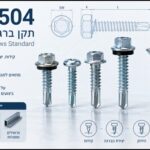
DIN 7504 – the standard for self-drilling (cladding) screws
12 בJuly 2026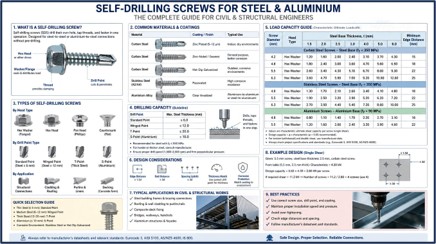
What Is a Self-Drilling (Cladding) Screw, and How Much Does It Hold?
An engineering guide to self-drilling screws for steel and cladding — loads, metallurgy and advanced sealing. In modern construction and in fixing roofing and cladding systems (such as corrugated cladding sheets or insulated panels), the choice of the right fixing element decides the service life of the whole structure.
In short
Weather, moisture, industrial air pollution and mechanical stresses demand a deep understanding of the screw’s properties, its level of corrosion protection, and its load capacity in the intended substrate. For corrosion, the ladder runs from cold galvanising (indoors only) through full stainless to the revolutionary bi-metal screw (a stainless body with a hardened carbon-steel drilling tip). ADIT’s ABE/BIE series drill up to 6.5 mm of steel and the AUTO/BAUTO series up to 12 mm with no pre-drilling. And the EPDM washer plays five simultaneous roles — sealing, chemical barrier, galvanic insulation, thermal-expansion compensation and shock absorption.
Corrosion protection solutions: from galvanising to the revolutionary bi-metal
A meeting of metals in an outdoor environment is fertile ground for corrosion that weakens the structure. To meet this challenge, there are several key metallurgical solutions:
- Cold (electrolytic) galvanising: a standard zinc coating intended mainly for indoor use or low-corrosion-risk environments. It provides basic protection, but prolonged exposure to moisture will quickly wear it away.
- Stainless steel: full stainless screws (A2 or A4 series) offer exceptional resistance to rust and harsh corrosive environments (such as coastal areas or chemical plants). However, stainless has a significant engineering limitation: it is a relatively “soft” metal, so a screw made entirely of stainless cannot drill into a steel structure by itself — its tip would deform and burn out.
- Bi-metal screws: the engineer’s dream solution. A bi-metal screw combines two worlds in one product: the screw body, thread and head are made of quality stainless (for maximum, long-term rust protection), while the drilling tip (the flute) is welded to it and made of hardened carbon steel. The carbon-steel flute drills and taps easily into the structure, while the outer stainless body remains completely immune to the weather.
ADIT’s professional connection solutions
ADIT provides the technology front line in self-drilling screws, precisely matched to the structure’s wall thickness and the required level of corrosion protection:
- ABE series (carbon steel): quality self-drilling screws of reinforced steel, for drilling standard and medium-thickness profiles and steel plates (maximum drilling capacity up to 6.5 mm of profile thickness).
- BIE series (bi-metal): the revolutionary version of the ABE series — a bi-metal screw combining a stainless body with a carbon-steel drilling tip, for outdoor applications that require complete rust protection at medium wall thickness.
- AUTO series (heavy duty for thick steel): especially reinforced carbon-steel self-drilling screws, designed for heavy-load work with a remarkable drilling capacity of up to 12 mm of steel profile thickness — with no pre-drilling!
- BAUTO series (bi-metal for heavy loads): the ultimate combination — a reinforced bi-metal screw able to drill into especially thick steel structures of up to 12 mm, while giving complete corrosion resistance thanks to its stainless body.
Load tables for a single screw (design and failure data)
The following data is based on the technical data sheets of ADIT’s leading screw series. The values are set out separately for pull-out (tension) and shear.
1. Load table for the ABE / BIE series (diameter 5.5 mm — ST5.5)
For fixing to thin and medium-thickness sheets and steel profiles.
| Base steel plate thickness | Pull-out failure NRk (kN) | Shear failure VRk (kN) | Pull-out design NRd (kN) | Shear design VRd (kN) | Recommended pull-out Nrec (kN) | Recommended shear Vrec (kN) |
|---|---|---|---|---|---|---|
| 0.8 mm | 1.9 | 1.9 | 0.8 | 1.0 | 0.6 | 0.6 |
| 1.5 mm | 3.0 | 1.9 | 1.2 | 1.5 | 0.9 | 1.0 |
| 2.0 mm | 3.8 | 1.9 | 1.6 | 1.5 | 1.1 | 1.0 |
2. Load table for the heavy AUTO / BAUTO series (diameter 5.5 mm — ST5.5)
For especially thick structures, direct drilling up to 12 mm of steel.
| Base steel plate thickness | Pull-out failure NRk (kN) | Shear failure VRk (kN) | Pull-out design NRd (kN) | Shear design VRd (kN) | Recommended pull-out Nrec (kN) | Recommended shear Vrec (kN) |
|---|---|---|---|---|---|---|
| 2.0 mm | 5.4 | 4.8 | 2.5 | 3.7 | 1.8 | 2.6 |
| 3.5 mm | 8.7 | 4.8 | 4.0 | 3.7 | 2.9 | 2.6 |
| 5.0 mm | 9.6 | 4.8 | 4.8 | 3.7 | 3.4 | 2.6 |
Important engineering note: the shear capacity in the tables does not account for tear-out of the profile itself (steel or aluminium). The designer must separately check the profile’s tear-out capacity to obtain the assembly’s final shear value.
Detail engineering: the five critical roles of the EPDM washer
The EPDM washer (ethylene propylene diene monomer) fitted under the screw head is not just a simple “rubber seal” — it is a complex engineering component with five simultaneous roles that keep the connection intact:
- Complete hermetic sealing against water and moisture: EPDM is an elastic polymer with excellent structural memory. Under tightening pressure it is compressed and precisely fills all the microscopic gaps between the screw thread, the drilled hole and the top sheet, thus completely blocking rainwater and moisture from reaching the interior of the structure.
- A chemical barrier and separation between substrates of different pH: acid rain, environmental pollution or reactions between different building materials create varying acidity or alkalinity (pH) at the connection area. Direct contact between metal and materials of opposing pH accelerates destructive chemical corrosion. EPDM is inherently resistant across an especially wide range of extreme pH levels and acts as a neutral barrier that prevents this chemical interaction.
- Preventing galvanic (electrochemical) corrosion: when two dissimilar metals (for example a steel screw and an aluminium or galvanised sheet) touch in the presence of moisture, an electrochemical cell (a tiny “battery”) forms. An electric current flows between them and rapidly corrodes the less noble metal. The EPDM washer is a complete electrical insulator that physically separates the screw head and its cap from the cladding sheet, breaking the electrical circuit and preventing the metals from decaying.
- Compensating for thermal expansion (thermo-mechanical stresses): cladding sheets and structural profiles expand in the sun’s heat and contract in the night cold at different rates (especially aluminium versus steel). A fully rigid fixing would cause the screws to shear or the drilled holes in the sheet to elongate. The EPDM’s elasticity allows controlled microscopic movement and absorbs the thermal shear stresses without losing the seal.
- Shock and vibration absorption: sheet and roofing structures are constantly exposed to vibrations from strong winds, roof-machine vibrations or other dynamic loads. The EPDM damps these shocks and prevents the screw from working loose over the years.
Common questions (FAQ) — self-drilling and cladding screws
What is the difference between an ordinary self-drilling screw (like the ABE) and a heavy-load screw (like the AUTO)?
The main difference lies in the length and structure of the drill flute at the screw tip. An ABE-series screw is for standard steel profiles and can drill a maximum thickness of up to 6.5 mm. The AUTO series, by contrast, is equipped with an especially long, reinforced drill flute that lets it penetrate especially thick profiles and steel beams (such as HEA/HEB) up to 12 mm thick in a single direct drilling — saving enormous work time and completely removing the need for tedious pre-drilling.
When must you use a bi-metal screw instead of an ordinary steel screw?
A bi-metal screw (such as the BIE or BAUTO series) is a must in two main cases: 1. When installing panels or sheets made of aluminium on a steel structure. Direct contact between steel and aluminium would create immediate galvanic corrosion that destroys the aluminium; a stainless bi-metal screw prevents this. 2. In any outdoor installation in areas with a harsh corrosive atmosphere, such as buildings within a few kilometres of the coastline, or plants and industries that emit chemicals and acids into the air.
Is it permitted to use an impact driver to install cladding and insulated-panel screws?
The unequivocal engineering recommendation is to use a fast screwdriver with a dedicated mechanical clutch, which allows a precise torque setting and automatic stopping the moment the seal seats against the sheet. An impact driver may be used only if the installer is highly skilled and stops the driving immediately as the screw seats. Over-tightening (“stripping”) caused by the impact’s hammering can strip and destroy the thread cut in the steel, void the screw’s load capacity, and crush and tear the EPDM washer.
How do you tell a screw was tightened correctly and the washer is working properly?
Correct tightening is judged by the state of the EPDM washer: the rubber should be lightly compressed under the metal cap, so its edges protrude uniformly and parallel to the sheet surface. If the rubber spills out, tears or deforms, that is a sign of over-tightening that destroyed the seal. If the washer can be turned with your fingers, or there is a visible gap, that is under-tightening that will cause water leaks and moisture ingress leading to corrosion.
How does the environment’s pH level affect the choice of screws and seals?
In acidic environments (such as heavy-industry areas or near chimney emissions) or alkaline environments (near concrete structures or cowsheds and coops that release ammonia), the corrosion rate of galvanised steel is extremely accelerated. In such environments only bi-metal (stainless) screws and quality EPDM washers must be used. The EPDM acts as a neutral material that insulates the stressed contact zone and can withstand extreme pH values without degrading (chemical breakdown), whereas simpler rubber seals will dry out and crumble within a short time.
Sources
- ADIT ABE / BIE and AUTO / BAUTO self-drilling screw series technical data sheets.
- ADIT bi-metal, stainless and galvanised coating specifications and EPDM washer data.