

Rosett Anchor or BA-NY Plug? Choosing a Drywall Fixing
12 בJuly 2026
Anchor Points for Work at Height: The Complete Guide to Safety, Standards and Signage
12 בJuly 2026
Chemical Anchoring to Concrete: Three Calculation Methods, a 25× Gap in the Result
Three completely different methods are used in Israel to calculate rebar dowels set in chemical adhesive — and they lead to results up to 25× apart. The familiar-but-inefficient (CCD), the unfamiliar-but-efficient (post-installed rebar), and the familiar-but-dangerous (the “Israeli method”).
In short
Chemical anchoring is one of the most common solutions in construction, but few realise that three completely different calculation methods are in use in Israel — and they can differ by a factor of 25. Choosing the wrong one can undermine structural safety, especially under earthquake loading. This article explains the difference between the CCD method, the post-installed rebar method and the “Israeli” method, and shows why one of them is clearly preferable: the post-installed rebar method is the simplest, the code-compliant and the most efficient choice for Israeli conditions.
What is chemical anchoring, and why does the calculation method matter?
A chemical (adhesive) anchor connects structural elements using an epoxy or polyester adhesive injected into a hole drilled in concrete. Unlike a mechanical anchor, it relies on the bond strength between the adhesive, the dowel and the concrete. The problem: there is no single accepted calculation method in Israel. The gap between the methods is not merely technical — it can be the difference between a safe structure and a structural failure.
Method 1: CCD — Concrete Cone Design
What it is
The CCD (Concrete Cone Design) method is anchored in the European standard Eurocode 2, Part 4: Design of Fastenings for use in Concrete. It treats the chemical anchor as a mechanical fastener and accounts for geometric parameters:
- spacing between anchors,
- distance from the concrete edge,
- anchor configuration (single or group).
Advantages
- Based on a recognised European standard.
- Allows precise calculation of complex geometries.
Disadvantages — and why it does not suit Israel
- Very large reductions: anchors in group configurations may lose up to 80% of their capacity after all the reduction factors. It is not unusual for a group of anchors to hold only about a fifth of a single anchor’s capacity.
- Not code-compliant for seismic design in Israel: the standard requires a C2 rating for seismic-risk regions such as Israel, and no chemical adhesive today holds a C2 approval. So any chemical-anchor seismic design by the CCD method is not code-compliant here.
- Complex manual calculation: most suppliers’ software cannot calculate CCD for C1 seismic, so it is done by hand — a long, error-prone process with many interacting parameters.
Method 2: The post-installed rebar method — recommended for Israel
What it is
The method is based on EAD 330087-00-0601: Systems for Post-installed Rebar Connections with Mortar — an extension of Eurocode 2 Part 1-1, the recognised standard for designing cast-in dowels (ordinary reinforcement).
This method treats the dowel as post-installed reinforcement (governed by the required bond length), not as a mechanical anchor. It is the method used in most of the world for designing rebar dowels with chemical adhesive.
Advantages
- Simple and efficient to design: the formula is far more direct than CCD, without dependence on many intersecting geometric parameters.
- Code-compliant for seismic design everywhere, including Israel: most adhesives on the market carry matching seismic data (C1/C2), with strength values identical across suppliers.
- More efficient results in most cases: although the method reduces the bond capacity to the concrete strength, its factors are less punishing than CCD’s, so the design values that come out are significantly higher.
- Tables and data available: many suppliers provide ready-made design data, allowing a uniform, near-identical calculation for almost every adhesive on the market.
Disadvantages
- No explicit shear calculation: shear is taken only from the dowel’s steel capacity, without the adhesive’s contribution.
- Bond capacity is capped at the concrete strength: you cannot “use up” a strong adhesive beyond the strength of the host concrete.
Method 3: The “Israeli method” — what is wrong with it?
What it is
The Israeli method was developed by a large design office in Israel and circulated in the market. It is not based on any official Israeli or European standard. It takes only the bond strength from the CCD method — without any of the reduction factors the European standard requires.
Why it is dangerous
The method ignores:
- the effect of spacing between anchors,
- the effect of proximity to the concrete edge,
- seismic reductions,
- group configurations.
The result is a calculated capacity far higher than reality — a design that looks safe on paper but does not actually meet the European standard.
A numerical comparison — a real case
Take a real case from an engineering calculation done on a construction project: three rows of Ø16 mm dowels, 10 cm between rows, 15 cm between dowels in a row (30 dowels in all), 18 cm embedment, B30 concrete, Hilti HIT-RE 500 V4 adhesive, seismic C1 design.
| Calculation method | Capacity per dowel (pull-out) |
|---|---|
| CCD for seismic C1 | ~300 kg |
| Post-installed rebar method | ~2,700 kg (9× the CCD) |
| The Israeli method | ~7,500 kg (25× the CCD!) |
A design by the Israeli method may assume a capacity 25 times higher than the true capacity under the European seismic standard. This is a gap that can endanger lives — not a marginal “technical” difference between calculation methods.
How to choose an adhesive and the right calculation method
Recommendations for designing a chemical anchorage
- Use the post-installed rebar method — the simplest, the code-compliant and the most efficient for Israeli conditions.
- Confirm the adhesive has seismic data per EAD 330087 — most adhesives on the market do.
- Avoid the CCD method for seismic projects — it is not code-compliant for earthquakes in Israel.
- Never use the Israeli method for structural projects — the capacity gap is not safe.
Adhesives for the post-installed rebar method
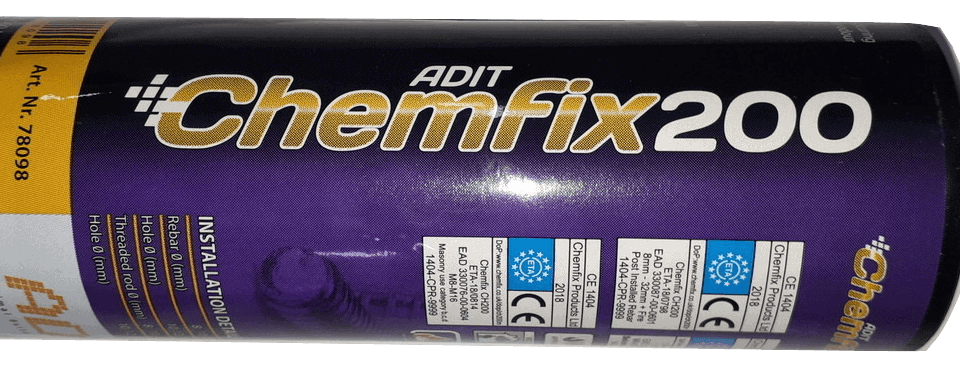
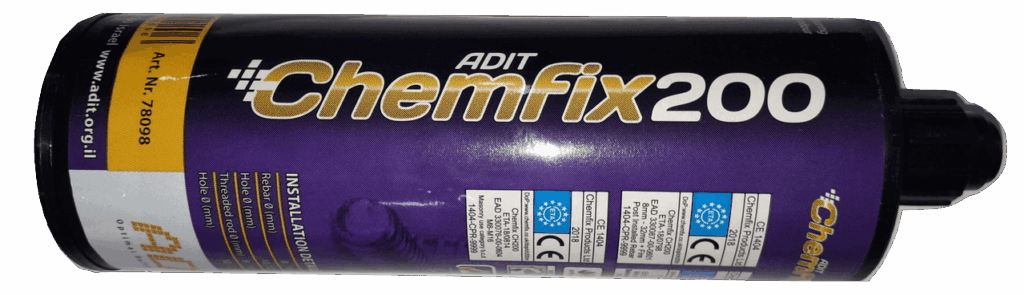
For a calculation by the post-installed rebar method, adhesives such as Adit Chemfix 100 and Adit Chemfix 200 set out the simple, efficient method on the third page of their technical data sheet.
Bottom line
In chemical anchoring, the calculation method is not a minor technical detail — it is the safety core of the project. The CCD method is less efficient and not code-compliant for seismic Israel; the post-installed rebar method is the recommended, code-compliant and efficient choice; and the “Israeli method” is dangerous and must not be used on structural work.
As awareness among engineers and designers grows, the post-installed rebar method is expected to replace the other two. It is only a matter of time.
Common questions
What is the practical difference between CCD and the post-installed rebar method?
CCD treats the chemical dowel as a mechanical anchor and applies a long list of geometric reduction factors — spacing between anchors, edge distance, group configuration — which can cut the resistance by as much as 80%. The rebar method treats the dowel as ordinary reinforcement and calculates the required bond length between steel and concrete, which in practice gives considerably higher design values and is simpler to compute.
Why is CCD unsuitable for seismic design in Israel?
The European standard requires category C2 for the seismic design of chemical anchoring in areas of seismic risk such as Israel. At present no chemical adhesive anywhere holds a C2 approval, so any CCD-based seismic design is effectively non-compliant in Israel.
Where does the factor-of-25 gap between the Israeli method and the European standard come from?
The Israeli method takes only the raw bond strength as it appears in the CCD method, and skips every reduction factor the European standard requires — anchor spacing, edge distance, seismic reductions and group configuration. In the worked example in this article — three rows of Ø16 mm dowels with Hilti RE 500 V4 — that is the gap between 300 kg under CCD for seismic design and 7,500 kg by the Israeli method.
Which calculation method is recommended for designers in Israel?
The post-installed rebar method under EAD 330087-00-0601, as the default. It is compliant for seismic design in any zone, considerably simpler to calculate, and in most cases yields a higher design resistance than CCD without any compromise on safety.
Can shear be calculated by the rebar method?
The rebar method offers no explicit shear calculation that includes the adhesive’s contribution. In practice shear is calculated from the resistance of the dowel steel alone, without adding bond strength to the shear calculation.
How do you choose an adhesive suited to the rebar method?
Confirm that the chosen adhesive has official seismic data under EAD 330087 — a figure most quality adhesives on the market now carry.
The Adit chemical anchor range
Four adhesives cover the great majority of jobs. Which one you need follows from the calculation method, the state of the concrete and whether there is a seismic requirement.
CT50Pro
Polyester chemical anchor with a European approval for uncracked concrete — threaded rods, rebar dowels and hollow blocks.
Chemfix200
Advanced hybrid vinylester chemical anchor for cracked and uncracked concrete, with C1 and C2 seismic approval.
AC500v4
Pure epoxy chemical anchor for cracked and uncracked concrete, with C1 and C2 seismic approval, and for dynamic loading.
Chemfix100
Advanced pure epoxy chemical anchor for cracked concrete, with C1 and C2 seismic approval.
Sources
- EN 1992-4:2018 (Eurocode 2, Part 4) — Design of fastenings for use in concrete (CCD).
- EAD 330087 — Systems for post-installed rebar connections with mortar.
- Adit Chemfix 100 / Chemfix 200 technical data sheets (post-installed rebar method).