
Which Anchor for Hollow-Core (Spancrete) Slabs — Standard and Efficient?
12 בJuly 2026
3 Methods for Calculating Post-Installed Rebar with Chemical Adhesive — a 25× Gap
12 בJuly 2026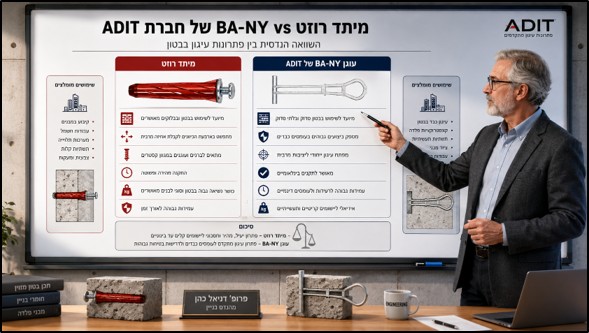
Rosett Anchor or BA-NY Plug? Choosing a Drywall Fixing
The BA-NY toggle plug versus the red Rosett anchor for plasterboard — a direct comparison of recommended service loads at both common board thicknesses, and why the locking mechanism matters.
In short
The BA-NY (an “American” toggle anchor) and the red Rosett (Expandet’s glass-fibre-reinforced nylon anchor) are both made for medium-to-heavy loads on plasterboard. On the manufacturers’ official recommended service loads, the BA-NY leads at both thicknesses: in a single 15 mm board it carries almost double the Rosett’s shear, and in a double 30 mm board it reaches 90 kg in tension — among the highest in the market. The Rosett’s edge is a smaller drill hole (10 vs 13 mm) and a better fit in narrow cavities. Both rely on spreading the load behind the board rather than on friction.
The BA-NY drywall plug — the engineering advantage
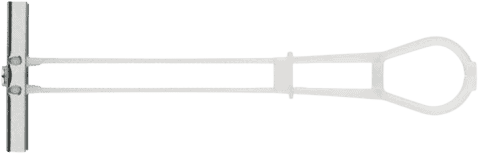
The BA-NY plasterboard plug (also known as an American “toggle anchor”) is one of the most reliable solutions on the market, thanks to its distinctive locking mechanism. Where other solutions rely on friction or a shallow surface thread, the BA-NY takes a different engineering approach that makes the most of the plasterboard’s own strength.
1. A wide bearing surface and optimal load spread
The great weakness of plasterboard walls is the material’s tendency to crumble under concentrated pressure. As the screw is driven, the plug’s nylon arms open behind the board and form a wide “fan”. Unlike a screw-in (“snail”) plug that concentrates on one small point, the BA-NY spreads the weight over a large surface — allowing significantly higher loads without tearing the board.
2. Medium-to-heavy loads at two thicknesses
There is a clear load hierarchy in drywall plugs, driven directly by board thickness:
- Single board (15 mm): an excellent solution for medium loads. Per the official figures, the BA-NY already gives a recommended service load of 49 kg in tension and 92 kg in shear in a single layer.
- Double board (30 mm): thanks to the rear-deployment mechanism, in a double wall (2×15 mm) it holds about 90 kg recommended service tension and 127 kg in shear — a preferred solution for hanging TVs, heavy shelves and kitchen cabinets.
3. Material durability, no wall damage
Many people reach for screw-in metal plugs, but those have long-term drawbacks: metal plugs with sharp “teeth” can cut the gypsum’s protective paper and weaken it over time. The BA-NY is made of a quality, flexible nylon and sits “flat” against the board without wounding the substrate — giving a stable fixing that does not loosen over the years.
4. Reliable installation — no “spinning on empty”
A common problem with simple plugs is that they start to rotate inside the hole as the screw is driven. The locking mechanism: the BA-NY carries small “wings” at its head that stop the plug turning in the drilled hole. Because the arms deploy and grip behind the board, the plug does not simply spin uselessly in the hole as some plugs do — the fixing seats positively. Once the screw engages, the rear mechanism locks firmly against the inner face of the wall, giving the installer a clear sense that the plug has taken hold.
5. Removable and re-installable
The mechanism lets you undo the screw and refit it without harming the connection — unlike spring-toggle plugs, where fully undoing the screw drops the anchor into the cavity and loses it.
6. No special installation tool
Unlike some other anchors such as the spring toggle, the BA-NY needs only an ordinary drill for installation — no dedicated setting gun.
Focused comparison: BA-NY vs the red Rosett (Expandet)
The Rosett is a glass-fibre-reinforced nylon anchor made by the Danish company Expandet Screw Anchors A/S. It comes in several models; the flagship for significant loads and thick boards is the red Rosett, officially rated for an 18–30 mm thickness range and double plasterboard. Per the manufacturer’s official data sheet (Technical Sheet No. 101), the Rosett’s load values are defined as recommended service loads (Nrec in tension, Vrec in shear) that already include a safety factor of 3 or more. Below is a like-for-like comparison at both defined thicknesses.
Case 1 — a single 15 mm board
With one 15 mm plasterboard sheet the figures show a clear advantage to the BA-NY:
- Recommended service load in tension: BA-NY 49 kg, against 38.7 kg for the red Rosett.
- Recommended service load in shear: BA-NY 92 kg, against only 51 kg for the red Rosett.
- Hole diameter: the BA-NY needs a 13 mm hole; the red Rosett needs 10 mm.
Bottom line: in a single 15 mm board the BA-NY is about 27% stronger in tension and about 80% stronger in shear.
Case 2 — a double board, 30 mm
With a double plasterboard wall — two 15 mm layers — the whole system carries considerably more weight, and here too the BA-NY keeps a clear engineering lead:
- Recommended service load in tension: BA-NY 90 kg, against 71.4 kg for the red Rosett.
- Recommended service load in shear: BA-NY 127 kg, against 86.7 kg for the red Rosett.
Bottom line: in a 30 mm double board the BA-NY is about 26% stronger in tension and about 46% stronger in shear.
A methodological note on comparing loads
Every comparison here uses the recommended service load (Nrec / Vrec) only, taken from the manufacturers’ official technical datasheets.
A fair comparison between products has to rest on exactly the same type of load. Comparing one product’s characteristic failure load (NRk) with another product’s recommended service load is not valid, because a failure load is at least three times higher than the recommended one.
Note also that the load figures shown on local Israeli reseller websites for these products are not always identical to the manufacturer’s official data, so it is worth verifying them directly against the original datasheet.
Summary table — recommended service load (Nrec) only
| Anchor | Recommended load (single 15 mm board) | Recommended load (double 30 mm board) | Drill Ø | Ceiling use | Plug material |
|---|---|---|---|---|---|
| BA-NY | Tension 49 kg · Shear 92 kg | Tension 90 kg · Shear 127 kg | 13 mm | Yes | Zinc-plated steel / nylon |
| Rosett Red | Tension 38.7 kg · Shear 51 kg | Tension 71.4 kg · Shear 86.7 kg | 10 mm | Yes (load ×0.8) | Nylon, 30% glass-fibre reinforced |
Methodological note: compare like with like. A characteristic failure load (NRk) must never be compared with a recommended service load (Nrec) — the service value already carries a safety factor of 3 or more, so the two are not on the same scale. Load figures shown on local Israeli reseller sites do not always match the manufacturer’s official figures; verify them against the original technical sheet.
Engineering findings
On the official data and the focused comparison, the BA-NY shows a clear technological lead and a resistance advantage over the red Rosett at both tested thicknesses. In a single 15 mm board it offers almost double the shear, and in a double 30 mm board it delivers the highest security in the market for especially heavy loads (90 kg service in tension). Its mechanism — deploying wings and an integral nylon strap — also allows the screw to be fully removed and refitted without losing the anchor in the cavity. The red Rosett, for its part, has a genuine advantage in a smaller drill diameter (10 vs 13 mm) and a fit for narrow cavities, but it remains the weaker solution in absolute load-carrying terms against the BA-NY.
Common questions
Why can’t a failure load (NRk) be compared with a service load (Nrec)?
Because the recommended service load already has a safety factor of 3 or more built in, while a characteristic failure load does not. Putting them side by side would overstate one product against the other; always compare service-to-service or failure-to-failure.
What is the BA-NY’s recommended service load in a double 30 mm board?
About 90 kg in tension (and 127 kg in shear).
Is the BA-NY stronger than the red Rosett?
Yes — at both thicknesses its recommended service loads are higher.
Which drywall plugs suit hanging a TV or heavy cabinets?
For heavier loads, use a plug with a documented, high service load such as the BA-NY (90 kg in a double board) or the red Rosett (~71.4 kg in tension in the same conditions). Light-duty plugs are not suitable for this kind of task.
How do the two locking mechanisms differ?
The BA-NY uses a nylon strap that pulls a metal profile open into wide horizontal wings behind the board — which also lets the screw be fully removed and refitted without losing the anchor. The Rosett works by an internal thread that shortens the nylon body and folds it into a knot (a “rosette”) behind the board.
Sources
- ADIT BA-NY toggle-anchor technical data.
- Expandet Rosett — Technical Sheet No. 101 (red Rosett, 18–30 mm).