

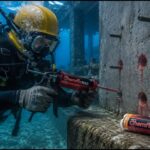
Underwater (chemical) anchoring: how to design it and how to install it
12 בJuly 2026
What is a chemical anchor, and what types are there?
12 בJuly 2026Underwater (chemical) anchoring: how to design it and how to install it
12 בJuly 2026What is a chemical anchor, and what types are there?
12 בJuly 2026Designing an Anchor Connection in a Natural Stone Wall
Concrete is a uniform material with clearly defined properties, so connections can be designed fairly precisely. A wall built of natural stone is a different problem altogether — it is rarely uniform, and the raw material carries its own uncertainty.
A single stone wall may contain cracks, voids large and small, moisture, several different types of stone, and zones that are more or less sound. Designing an anchor connection into it means working with that variability rather than against it.
Start by accepting the uncertainty
In a natural stone wall, even five separate pull-out tests with good results are no guarantee that the sixth anchor will carry the same load. The uncertainty of the raw material has to be built into the design: avoid concentrating too much load on any single anchor, and, as a rule, go deeper — particularly with chemical anchoring, to create a larger bond area.
The three-step approach
- Mapping — identify the zones of the wall and define them clearly.
- Assessment — for each zone, estimate the anchor’s load capacity from the type of stone and the condition of the wall.
- Testing on site — carry out pull-out tests to confirm that the initial assessment was correct.
Which anchor suits natural stone?
Which anchoring solutions actually suit a connection in natural stone? We examined the three anchor types most commonly used in construction and cladding projects:
| Anchor type | Behaviour in natural stone | Suitability |
|---|---|---|
| Chemical anchor | Works in every type of stone (sometimes with reduced load vs concrete); distributes stress along the whole anchor and borehole; requires skill | The best option |
| Concrete screw | Surprisingly good; pull-out loads similar to those in concrete in hard stone, limestone and Jerusalem stone; spreads load over the thread | A genuinely good option |
| Wedge anchor | Disappointing to very disappointing in stone; stresses concentrate at the expansion clips | Not recommended |
1. Chemical anchor
The best option, because it distributes stress along the whole length of the anchor and the borehole and works in every type of stone — sometimes with a reduction in load compared with concrete. In hollow or voided stone the work becomes considerably more complicated and is not recommended without training and experience; there, use a mesh sleeve designed for chemical anchoring in hollow materials.
2. Concrete screw
In every test I have carried out in hard stone, limestone or Jerusalem stone, the concrete screw held pull-out loads similar to its capacity in concrete. The strength comes from the thread cutting into the walls of the borehole and spreading the load evenly over roughly 100 mm. Place it in the harder, less-cracked zones where you can — but in many cases it is a genuinely good choice: very easy to install, with a capacity that is a pleasant surprise.
3. Wedge anchor
A standard choice in rock-climbing and abseiling literature from the US and Europe — yet in most of my pull-out tests in stone walls the results ranged from disappointing to very disappointing. The likely reason is that all the stresses concentrate around the expansion clips (unlike the concrete screw, whose thread engages over some 100 mm). That concentrated local pressure leads to rapid failure and splitting of the stone.
Why spreading the load matters
Unlike reinforced concrete, natural stone can contain voids, microscopic cracks and weaknesses that cannot be seen. Concentrating a high load on a single anchor can break the stone locally around the fixing. Spreading the load across several anchors, spaced well apart, and increasing the embedment depth to build a larger bond area, is what gives the connection its stability.
Further information and common questions
What do you do if you find hidden voids inside the stone while drilling?
When you hit internal voids in the stone, a mechanical anchor will fail, because there is no continuous surface for it to grip and expand against. An ordinary chemical anchor becomes awkward too: the adhesive runs away into the void instead of enveloping the threaded rod. The professional answer is a perforated mesh sleeve made for chemical anchoring into hollow substrates, which holds the adhesive in place and lets it form a wide mechanical key against the sound stone around the hole.
Why does spreading the load matter so much in natural stone walls?
Unlike reinforced concrete, natural stone can contain natural veins, microscopic cracks and weak points that are not visible from the outside. Concentrating a high load on a single anchor can split the stone locally around the anchorage. Spreading the load over several anchors set well apart, together with a deeper embedment that creates a larger bonded area, is what gives the connection its stability.
Field pull-out tests on natural stone — video
Three site tests, filmed on real stone cladding — one eye bolt and two chemical adhesives.
Pull-out test — Bteye2 eye bolt.
Pull-out test — Chemfix100 chemical adhesive.
Pull-out test — CT50Pro chemical adhesive.
Ministry of Justice, Jerusalem
Stone cladding anchored on the Ministry of Justice building in Jerusalem — one of the projects where these tests were carried out.