

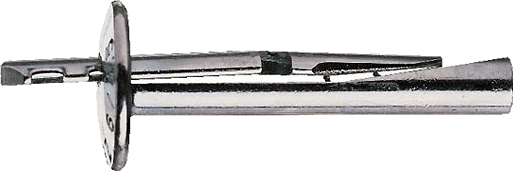
AN-CU Nail Anchor

AN-CU Nail Anchor

Hammer-in nail anchor with the European ETA1 approval – for cracked and uncracked concrete, with a flush head.

ETA1 – cracked concreteHammer-setDynamic loadsFire standardFlush head
ETA1

Cracked & uncracked
Hammer

Fast installation
Flush

No protrusion

Fast Installation in Volume

The AN-CU is a hammer-in nail anchor: drill through the fixture, insert the anchor, drive the pin with a hammer. No threading, no torque – one action.

What sets it apart: despite the fast installation, the AN-CU carries a European ETA1 approval for cracked concrete and an approval for dynamic loads – not something to take for granted in a hammer-set anchor. The head is flush and does not protrude.

Technical Specification

CharacteristicsHammer-in nail anchor
SteelCarbon steel
TechnologyHammer-set
Cracked concreteYes
Dynamic loadsYes
Fire standardYes
ApprovalsEuropean ETA1 for cracked and uncracked concrete

Files to Download

Frequently Asked Questions

What is the difference between the AN-CU and the NA?

Both are hammer-set anchors with ETA1. The AN-CU is a nail anchor with a flush head – exceptionally fast, for volume work. The NA is a hammer-in wedge anchor, available in a range of heads (including eye and hook).

Can a hammer-set anchor be removed?

No. Driving it expands the anchor irreversibly. If removal and re-use are needed, move to the TFE concrete screw.

Large volumes of fixings? Tell us the load and the concrete type – we will recommend the anchor and diameter.

Contact our engineers

Instruction Videos

The nail anchor in the prints of concrete ADIT AN-CU+ with European approval ETA

Looking for a quick, standard and safe solution to the acoustic ceiling, tinways, merging or captivating movies from steel to the concrete ceiling? Working on complex engineering projects, the execution speed plays a critical role, but it is not allowed to be carried out at the expense of safety and conforming to standards. The leading professional solution in the construction market today is The Nail anchor anchor in the fabric (Nail Anchor) by Ceiling Anchor ADIT AN-CU+.

anchor ADIT AN-CU+ It is a dedicated mechanical metal anchor (Wedge-type, hammer-drive) made of a hard and complex steel, designed to quickly install a hammer-click into solid concrete. The anchor is an official approval (ETA 24/1214) for multi-constructive systems (Redundant Non-structural Systems), and ensures engineers and complete peace contractors and an exceptional resistance over time.

The mechanism of operation and installation of a hard nail anchor (AN-CU+)

Unlike nylon plug, the regular seas that require long-standing smuggling, the AN-CU+ anchor is based on the advanced Pin & Wedge mechanism. The anchor is directly sled through the part designed to sink into the drilling hole in concrete. The installation mechanism is carried out in 4 simple steps:

  1. The drilling: The quaints are circulated in diameter 6 mm and the standard indicated in the manufacturer’s specifications (at least 40 mm), using drill bit is suitable for a hammer.
  2. The cleaning of the fever: Clean the interior of the battle hole and the concrete snoring through a dedicated air pump and brush – a critical stage for ensuring full expansion.
  3. The room: Destroy the anchor through the fixed element (such as profile or hanging out) directly into the hole until the head of the anchor is connected with the surface.
  4. Infected in the fabric: Stick with a hammer in the face of the prominent metal. The penis injection pushes the extended range against the concrete spsies and creates a constant and immune lock.

The leading Advantages of the Nanille anchor in Addica from Addict (ADIT AN-CU+)

  • approval is a comprehensive engineering: The approval official ETA 24/1214 The visa uses coscively from two in cracked and uncracked concrete.
  • resistance is shown in fire (Fire Resistance): The anchor was tested and happy for resistance at high fire temperatures for up to 120 minutes (R120), making it ideal for the delivery of fire protection systems and sensitive infrastructure.
  • Dramatic savings during work: Direct installation with a hammer click without the need for screws or keyboard keys, which shortens the installation times on the site by tens of percent.
  • A wide and safe head: A broad-headed design that ensures the perfect combination of tracks and printers without breaking or weakening.
  • Protection of originia: A quality zinc plated (Zinc plated) that provides an excellent resistance in interior and dry structure.

Technical data and President’s fitness – ADIT AN-CU+ Series

The anchor is designed for work in concrete Hard and compressed (Solid Base Materials) and provides high-prepared value in the fast anchoring category for the ceilings.

Model and MacTThe drilling (mm)Minimum hole depth (mm)Minimum concrete thickness (mm)Recommended load in all directions ($F_{rec)coating and material
ANCUP06040640802.0 kN (about 200 kg)Carbon steel from the holoon
ANCU06070640801.2 kN (about 120 kg)Carbon steel from the holoon

* Please take a minimum distance of 70 mm between anchors and a minimum distance of 70 mm from the concrete element, depending on the guidelines of the European standard.

Common Questions and Answers (FAQ) – Nillin Anchor in Daffi and anchoring solutions for the Crimea

What is the Nail Anchor and is it made of Manylon?

Despite the sometimes misnamed in Hebrew, anchored ADIT AN-CU+ It is not a plastic plastic phips, but Full metal anchor (Steel Nail Anchor) The source of the name is from the English word nail (mart), because of the fact that its installation is carried out by a nail-like pelvic pelvic pelvic using a hammer. It is designed for far higher loaders than nylon plug to ordinary plastics and is safe for the use of the cartoons.

Why is it important to use an ETA 24/1214 anchor in concrete?

You have hung systems above human heads (crackers, canals, lighting bodies) requires resistance as aggressive failure. approval The European Technical Assessment of the AN-CU+ model ensures that the anchor has undergone a rigorous and happy laboratory test series for use in multiple non-constructive systems, where a single anchor failure will not lead to the collapse of the entire system.

What is the difference between an hooked pelvic anchor and a regular plastic nylon plug with a screw-up?

nylon plug nylon with a screw-up is mainly designed for walls, hollow blocks and light applications that are not under regular stretch load (such as a ceiling hanging). Plastic (Nilone) suffers from the “Creep” phenomenon under continuous stretch load, and therefore is strictly forbidden to use constructively. On the other hand, The Nail anchor anchor in the fabric Made of a full carbon steel, is not old or released, providing a stable and absolute mechanical grip in concrete.

Is ADIT ANCU+ anchor suitable for the use of the walls of hollow blocks hollows or teung?

No. The ANCU+ anchor is specifically designed for working in concrete solid and dialogue (Solid Base Materials). His trio mechanism requires a dense and strong infrastructure material to develop and pressure against him. To install hollow blocks loops or hollow block Itong should be used in nylon plug designated for the materials of the ovarians or Chemical anchors that are suitable for these infrastructure.

How does resistance affect fire (Fire Resistance) on the selection of the anchor in project?

In the case of a fire in the building, extreme heat causes plastic elements to immediately dissolve, leading to the fall of cable channels and fire infrastructure, and endangering the rescue forces. The Interim anchor AN-CU+ holds the resistance ranking in official fire of up to 120 minutes (R120), which maintains the fullness of mechanical connection even at extreme temperatures in emergency.

Can we pull or break the candlestick after its suffocation?

The ANCU+ anchor is defined as a solution of the hamper-proof solution. Once the penis is washed and locked in the anchor body, it cannot be washed out or swiped out in normal ways. If necessary to break the connected element, the common solution on the ground is cutting the head of the anchor that is merged with the help of an angle (disc) ointment.