

What anchor is suitable for my stone cladding?
12 בJuly 2026
Maximum tightening torque for bolts and nuts
12 בJuly 2026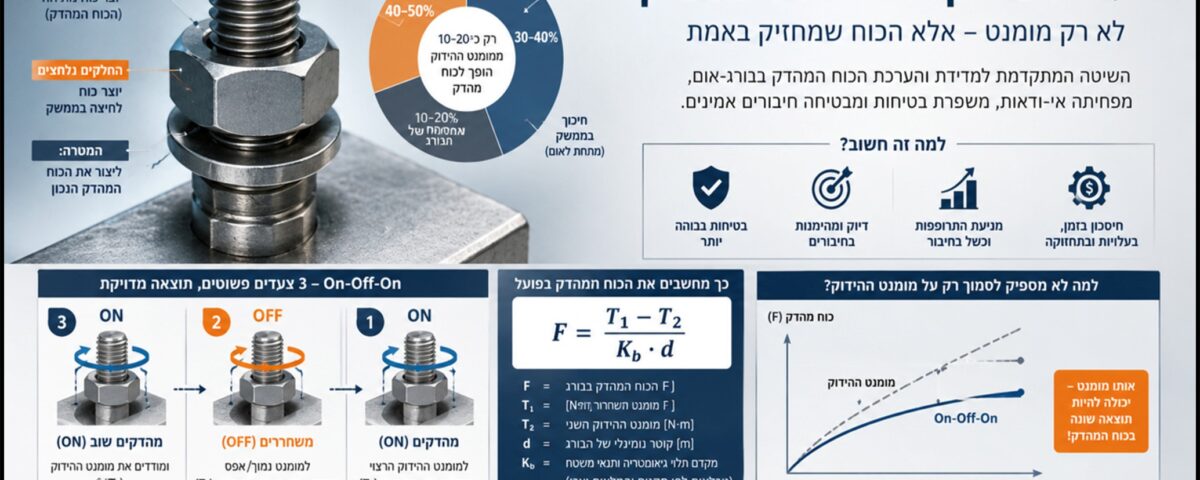
Bolt and Nut Tightening Test: the On-Off-On Method
When you tighten a bolt, only about 10 to 15% of the torque actually becomes clamping force — the rest is spent on friction. That is why torque alone is a poor measure of how tight a joint really is, and why the On-Off-On method exists.
Why torque is a poor measure of clamp force
A small change in friction changes the relationship between torque and clamp force dramatically. Because roughly 85% of the applied torque is consumed by friction, a single torque reading cannot tell a well-tensioned joint apart from one that is merely stiff with friction but has little real preload.
Where the torque goes
As you tighten, the torque on the wrench splits three ways:
- Thread friction — between the bolt thread and the nut thread.
- Bearing-face friction — under the nut, or under the bolt head if that is the part that turns.
- Actual tensioning — the only part that creates clamp force.
How the torque divides between the three depends on the friction coefficient, but in practice 85% to 90% of it is spent on friction. For a typical coefficient of μ = 0.12, only about 14% of the applied torque goes into actually tensioning the bolt; the remaining 86% is lost overcoming friction in the thread and under the bearing face.
Why loosening torque is lower than tightening torque
In a freshly tightened bolt, the torque needed to start loosening it is always smaller than the torque used to tighten it — typically by 10 to 30%. When tightening, friction works against you, so the wrench must overcome friction and stretch the bolt. When loosening, the tension stored in the bolt helps to undo it, and friction is the only obstacle.
Why a connection needs checking after the event
In many applications — foundation anchors, steel connections, flanges, rails — it is the clamp force, not the torque, that decides whether the connection works. The problem is that after tightening, the clamp force tends to fall.
Force loss without the thread rotating
- Stress relaxation — the material sheds stress over time.
- Embedment — surface irregularities bed down under contact pressure.
- Creep — slow continuing deformation, mainly at elevated temperature or through gaskets.
Force loss with the thread rotating
- Self-loosening — from vibration, cyclic loading or impact.
A quality-control method is therefore needed that can confirm, after the fact, that the connection is still tightened as required.
Worked example — an M12 bolt
An M12 bolt in coarse thread, pitch p = 1.75 mm. The measurement gives:
- TOn = 80 N·m = 80,000 N·mm
- TOff = 60 N·m = 60,000 N·mm
So: F = π × (80,000 − 60,000) / 1.75 ≈ 35,900 N ≈ 36 kN.
The clamp force in the connection is about 36 kilonewtons, roughly 3.6 tonnes — a figure that no single torque reading could have told you.
Range of validity and accuracy
Experience shows that the On-Off-On method depends on the friction coefficient (μ) of the connection: the lower the friction, the more accurate the method.
| Friction coefficient μ | Accuracy | Typical condition |
|---|---|---|
| up to 0.08 | accurate | lubricated bolts, release coating, clean surfaces |
| 0.08 – 0.18 | good | standard dry bolts, electroplated zinc |
| above 0.25 | not accurate | hot-dip galvanising, corrosion, dirt |
The sooner the check is carried out after tightening, the more reliable the result — corrosion has not yet had time to change the friction coefficient.
How does it compare with ordinary torque control?
In conventional torque tightening, the accuracy of the estimated clamp force is 17%–33%, mainly because the friction coefficient is not known precisely. The On-Off-On method holds the same range or improves on it — except with hot-dip galvanising and comparable high-friction conditions, where it loses its advantage.
The usual test methods, and their limits
Tightening is normally measured through torque, simply because there is no cheap and simple way to measure the clamping force directly. The three common methods:
| Method | How it is done | The drawback |
|---|---|---|
| On-torque | Measure the torque to start the bolt turning a few degrees in the tightening direction | Tightens the joint further; very sensitive to friction; cannot separate high friction from high preload |
| Off-torque | Measure the torque to start it turning a few degrees in the loosening direction | Slightly loosens the joint; the same sensitivity to friction |
| Mark and re-torque | Mark the position, loosen a little, then measure the torque needed to return to the mark | Better, but it disturbs the joint |
The On-Off-On method
The On-Off-On method reads the torque at three steps and, crucially, leaves the joint as it found it:
- On — measure the torque needed just to start rotation in the tightening direction.
- Off — measure the torque needed just to start rotation in the loosening direction.
- On — re-tighten the bolt back to its original position, so the test does no harm to the connection.
Because friction acts in both measurements, the difference between the two almost completely cancels it out, leaving only the part that comes from the clamp force. From that difference, together with the thread pitch of the bolt, the true clamp force can be calculated.
Practical recommendations
- Use a precise torque wrench. The method relies on the difference between two readings, so a small error in either is magnified — a digital wrench with a peak (recorded) reading is best.
- Measure the break-away torque, not the running torque: the value that matters is the point at which the bolt just starts to move.
- Do not skip the third step. Returning the bolt to its original state is part of the method, so the joint is not left loosened.
- The sooner you test after tightening, the more reliable the result — before friction has had time to change through corrosion.
Common questions
Why can a single torque reading mislead?
Because about 85% of the torque goes into friction, one reading cannot distinguish a properly tensioned joint from one with high friction and low clamp force.
The result comes out negative — what does that mean?
It means the loosening torque was larger than the tightening torque, which happens when corrosion, dirt or oxides have driven friction above the clamp-force contribution. It is a clear sign that the method does not apply to that connection.
Does it work for concrete anchors?
The principle is the same, but a mechanical anchor spends part of its torque on its own expansion, and a chemical anchor is a completely different connection. The method applies directly to steel bolt-and-nut joints; for anchors, work from the ETA approval and the manufacturer’s instructions.
In summary
Torque is what we apply; clamp force is what actually holds the connection together. The gap between the two is governed by friction — the least known and least stable term in the equation.
The On-Off-On method does not try to guess the friction coefficient: it cancels it out. Two straightforward torque measurements — tightening and loosening — together with the formula F = π × (TOn − TOff) / p give a direct estimate of the clamp force in the joint, using tools that are already in every inspector’s box.
Like any method it has its limits: it needs low to moderate friction, calibrated tools, and a check carried out close to the time of tightening. Within those limits it gives an answer that an ordinary torque check simply cannot.