



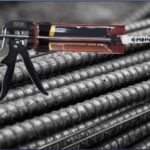
epoxy adhesive to rebar: The Perfect Solution for anchoring in Professional Construction
12 בJuly 2026
Cracked concrete and anchoring: frequently asked questions
12 בJuly 2026epoxy adhesive to rebar: The Perfect Solution for anchoring in Professional Construction
12 בJuly 2026Cracked concrete and anchoring: frequently asked questions
12 בJuly 2026Crooked anchors: common questions about incorrectly installed anchors
Installing anchors in a non-compliant way is almost the norm on site. That may also be why the standards apply so many safety factors to them.
But how much should these defects worry us? When can they be passed quietly, and when must they be corrected? Can such cases be prevented altogether, or at least reduced? Those are the questions this article sets out to answer. We will focus on mechanical anchors — chemical anchoring will be covered in the next article.
1 — What defects are we talking about?
1.1 — Installing the anchor at a depth other than specified
Wedge anchors that were cut off, because the contractor could not install them to the required depth.


1.2 — Installation at an angle
Installation at an angle happens when the installer cannot drill straight. There is also a third defect — a partial installation, without applying the required tightening torque on anchors that expand inside the concrete. That one is a special case, and we will address it separately.


2 — Why does the installer get it wrong?
The reason for these installations is that, while drilling into the concrete, the installer hits reinforcement they cannot drill through.
At that point they have two options: drill at an angle, or install to a shallower depth. Both produce a non-compliant installation.
3 — How much load capacity is lost between a correct and an incorrect installation?
In tension (pull-out)
An angled installation creates three main weaknesses:
- The concrete cone is much smaller, and shallower.
- The zone where one drilled hole sits close to another is an area of significant weakness.
- The anchor does not work in tension, but in bending.
The problem is not only that the load capacity in bending is far lower than in tension. It is that the crooked anchor does not behave like the other, correctly installed anchors. Its stiffness and deformation differ from those of a sound anchor, so the anchors do not work together.

This is exactly why you must never mix anchors of different types, or even of different diameters. In short: the contribution a single crooked anchor adds to three correctly installed anchors is very small in tension.
In shear
In shear the picture is quite different. What governs is the anchor's position relative to the concrete edge:
| Scenario | Effect of the angled installation |
|---|---|
| Anchor close to the concrete edge, angled towards the edge | Significant reduction in the concrete edge capacity |
| Anchor close to the concrete edge, angled away from the edge or parallel to it | Only a small reduction in the calculated embedment depth |
| Anchor far from any edge (steel failure governs) | Almost no effect — the same as a straight anchor, or even better |
In other words: if the anchors work mainly in shear, and none of them is angled towards the edge, then several anchors being installed crooked has almost no impact.
If the main load on the anchors is in tension, then depending on the installation angle you must reduce the load capacity of the crooked anchor by between 50% and 100%.
4 — How to reduce the chance that the contractor has to install at an angle
Good design is the best defence. The practical ways to reduce the risk:
- Use slotted holes — where there is no shear in the direction of the slot. This lets the contractor move the drill rather than tilt it. Note that slotted holes often require an oversized washer.
- Avoid placing anchors on a single line wherever possible, to reduce the chance that several anchors land on reinforcement and all end up crooked.
- Provide extra holes in the profile, leaving the contractor alternative positions if they hit reinforcement while drilling.
- Design to a maximum of 75% of the approved load capacity for anchor failure, so that the remaining anchors can compensate for one that is installed incorrectly.
- Avoid large-diameter anchors where concrete cone failure governs: the larger the anchor, the more likely it is to hit reinforcement — and with expansion anchors, a larger diameter also generates greater tension in the concrete.
Note that the last two points pull against each other: larger anchors can cover for a badly installed one, but larger anchors are also more likely to hit reinforcement. Judgement is needed between the two, according to the conditions of the project.
5 — What to do when an anchor has been installed incorrectly
Once a crooked anchor has been found, there are several ways to improve the situation:
Welding to the profile
The anchor can be welded to the profile, with or without an added steel plate, to stop it working in bending. This certainly improves matters, and makes the anchor start working together with the others immediately, without a bending phase. It does not, however, solve the problems of reduced embedment depth and a reduced concrete cone.

Adding anchors
You can add holes in the profile for additional anchors, but you must allow for the minimum spacing between anchors, and check how much a new anchor next to the existing ones will actually contribute — quite apart from the practical difficulty of drilling on site through a profile that sits tight against the concrete.
Welding an extension to the profile
An extension can be welded to the existing profile, and new anchors installed through it.
Additional plates — a solution without welding
If welding is not wanted, and the existing anchors are threaded and protrude more than 10 mm above the existing profile, additional plates can be fixed onto the protruding anchors.


Replacing with chemical anchors
If the fixings are concrete screws, which are easy to remove, they can be replaced in the same positions with chemical anchors, which will be stronger.
Conclusion
The problem of crooked anchors can and must be tackled — through sound design, an understanding of the risk the phenomenon carries, a knowledge of how to remedy such cases, and an appreciation of the danger of leaving them untreated.
Key points
- A crooked anchor in tension: a 50%–100% reduction in load capacity, depending on the angle.
- A crooked anchor in shear, far from an edge: minimal effect on performance.
- Anchors of different types do not work together — never mix them.
- Designing to 75% of the load capacity gives a safety margin for anchors that end up incorrectly installed.
- Welding the anchor to the profile allows proper load distribution together with the remaining anchors.
- Next article: chemical anchors, and the effect of incorrect installation on them.