
What is a self-drilling screw?
12 בJuly 2026
How to calculate the load capacity of a bolt and nut
12 בJuly 2026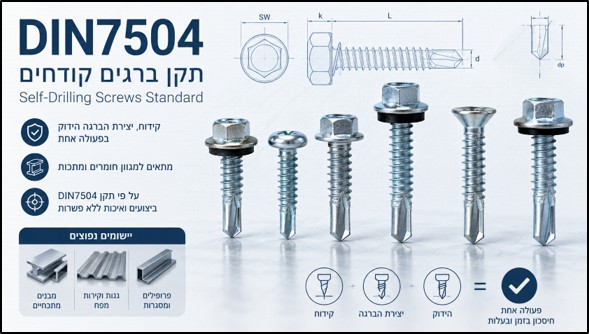
DIN 7504 — The Standard for Self-Drilling (Cladding) Screws
DIN 7504 is one of the most common and important standards in the world of fasteners, defining the technical specification for self-drilling screws — often called cladding screws or “sheet-to-sheet screws”. These screws revolutionised construction and metalwork thanks to their ability to perform three actions in one blow: drilling, tapping and tightening.
In short
Screws made to DIN 7504 have a drill-point tip that removes the need to pre-drill a pilot hole. The standard divides into sub-types by head form: DIN 7504K (hex head with a flange, the most common in light construction and roofing), DIN 7504N/M (pan head), and DIN 7504P (countersunk). Screws are made of hardened carbon steel, stainless (A2/A4) or bi-metal, and for outdoor use an EPDM sealing washer is critical — it seals against water, insulates vibration and protects the sheet’s paint.
The essence of the standard and the technical mechanism
Screws made to DIN 7504 are fitted with a drill-like tip (drill point). This design removes the need to pre-drill a pilot hole.
- The drilling action: the screw tip drills into the material (usually sheet metal or steel/aluminium profiles).
- Creating the thread: after drilling, the screw body — with a self-tapping thread — forms the internal thread inside the material and tightens to it.
- Efficiency: using these screws saves significant work time, reduces the wear of separate drill bits, and prevents mismatch errors between the hole and the screw.
Internal classifications in the standard (head types)
DIN 7504 does not refer to a single screw type; it divides into sub-standards by head shape and driving method:
- DIN 7504K (hex head with a flange): the most common in light construction and roofing. The hex head allows a high torque transfer, and the built-in flange (washer) provides a large surface area for tightening. Usually combined with an EPDM seal to prevent water ingress.
- DIN 7504N / DIN 7504M (pan head): has a rounded head, used to connect thin sheet metal where an aesthetic, less prominent finish is required.
- DIN 7504P (countersunk): the head sinks into the material and creates a flat surface. Used to connect wood to metal or where the screw head cannot protrude.
Materials and coatings
The screws are made of different materials to suit the working environment:
- Hardened carbon steel: the most common material, heat-treated to give it the hardness needed to drill into metal. Usually comes with a zinc-plated coating for corrosion protection.
- Stainless steel: screws in A2 (304) or A4 (316) exist for especially corrosive environments. However, it is important to remember that stainless is softer than hardened steel, which is why bi-metal screws exist — only their tip is made of drilling steel and the body is stainless.
The importance of the EPDM washer in outdoor installations
When using DIN 7504 screws (especially the K type) for outdoor cladding, roofs or wet environments, using a sealing washer is critical. The most common and recommended washers are made of EPDM rubber.
- Perfect watertight sealing: the EPDM material is highly resistant to UV rays, ozone and extreme temperature changes, which prevents the washer drying out, cracking or crumbling over the years. It forms a completely sealed layer between the screw head and the sheet, and prevents rainwater ingress.
- Vibration insulation: the washer absorbs vibrations caused by strong winds or building movement, thereby preventing the screw from working loose over time.
- Preventing damage to the sheet: the soft washer prevents the hard screw head from scratching or crushing the paint coating of the cladding sheet during tightening.
Notes for correct use
To ensure the screw’s efficiency per DIN 7504, pay attention to the following parameters:
- Drilling capacity: every screw diameter has a maximum metal thickness it can drill (usually between 2 mm and 12 mm depending on the model). Working beyond the capacity will break the screw tip.
- Drilling speed: drilling too fast can burn the screw tip, while drilling too slowly will not penetrate the material efficiently.
- Type of driver: use drivers with an adjustable clutch to prevent over-tightening, especially when working with EPDM washers (which must not be over-crushed).
In summary, DIN 7504 screws are the backbone of modern metalwork and light construction. Understanding the standard’s sub-types lets designers and installers choose the most precise screw for the required application, ensuring structural strength and long-term durability.
Common questions (FAQ)
Can you drill with a DIN 7504 screw directly into concrete or wood?
No. These screws were designed and specially hardened (by heat treatment) to drill into steel, aluminium or sheet metal. Trying to drill with them into concrete would destroy the screw tip immediately. For wood, there are dedicated self-drilling screws (sometimes with “wings”) that prevent the drill channels clogging with sawdust.
What happens if I skip the EPDM washer when installing a roof?
Skipping the EPDM washer in an outdoor connection will certainly lead to water ingress around the drilled hole. The water will cause accelerated rusting of the screw, the sheet and the steel structure beneath. In the long term, the rust will weaken the anchor point to the point where the roof could tear off in a storm.
How do I know how much to tighten a screw with an EPDM washer?
Correct tightening is achieved when the washer is pressed evenly against the sheet and expands slightly (about 1–2 mm) beyond the diameter of the screw’s metal flange. If the washer is crushed and “spills” out prominently, or if it deforms, that is a sign you have over-tightened and the rubber may tear. Using a clutch driver will prevent this.
Can a stainless DIN 7504 screw drill into a thick steel structure?
Usually not. Stainless is a metal highly resistant to corrosion, but it is not hard enough to drill into building steel without its drill tip melting or breaking. The solution is bi-metal screws, in which the drilling tip is made of hard carbon steel welded to a stainless body.
What is the practical difference between a DIN 7504K head and a DIN 7504N head?
The main difference is in torque transfer and surface finish. DIN 7504K (hex head) allows the use of a hex socket, which transfers very high torque with no risk of the bit slipping, making it ideal for demanding work and drilling into thick steel. DIN 7504N (pan head with a Phillips or Torx recess) is usually chosen for aesthetic reasons or in connections of thin profiles where a smoother finish is required.
Sources
- DIN 7504 — Self-drilling screws with tapping screw thread (parts K / N / M / P).
- ADIT self-drilling screw and EPDM washer technical data.