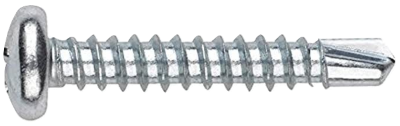
ABR Self-Drilling Dome Head Screw
Pan head (dome head) self-drilling screw that pierces and threads into steel and aluminium profiles in a single action — no pre-punching, no pre-drilling. Made of C1035 steel with a cold-galvanized coating, PH2/PH3 bit, and approved pull-out and shear data for safe structural design.
The Adit self-drilling screw family
Choose the right self-drilling screw for your head profile, bit and environment.
Approved technical data — connection to steel & aluminium profile
The following data forms the basis for safe structural design. All values are in kN per single screw and include characteristic failure loads (Nrk/Vrk), design loads (Nrd/Vrd) and recommended service loads (Nrec/Vrec). For engineering design an appropriate safety factor must be applied, and the engineer must also verify the tear-out capacity of the profile itself.
ST 4.8 — connection to steel profile
| Load parameter (kN) | Steel thickness 2 mm | Steel thickness 3 mm | Steel thickness 4 mm |
|---|---|---|---|
| Failure load — pull-out (Nrk) | 5.7 | 7.1 | 7.1 |
| Failure load — shear (Vrk) | 3.6 | 3.6 | 3.6 |
| Design load — pull-out (Nrd) | 2.6 | 3.9 | 5.2 |
| Design load — shear (Vrd) | 2.7 | 2.7 | 2.7 |
| Recommended load — pull-out (Nrec) | 1.9 | 2.8 | 3.7 |
| Service load — shear (Vrec) | 2.0 | 2.0 | 2.0 |
ST 5.5 — connection to steel profile
| Load parameter (kN) | Steel thickness 2 mm | Steel thickness 3.5 mm | Steel thickness 5 mm |
|---|---|---|---|
| Failure load — pull-out (Nrk) | 5.4 | 8.7 | 9.6 |
| Failure load — shear (Vrk) | 4.8 | 4.8 | 4.8 |
| Design load — pull-out (Nrd) | 2.5 | 4.0 | 4.8 |
| Design load — shear (Vrd) | 3.7 | 3.7 | 3.7 |
| Recommended load — pull-out (Nrec) | 1.8 | 2.9 | 3.4 |
| Service load — shear (Vrec) | 2.6 | 2.6 | 2.6 |
ST 4.8 — connection to aluminium profile
| Load parameter (kN) | Aluminium thickness 2 mm | Aluminium thickness 3 mm | Aluminium thickness 4 mm |
|---|---|---|---|
| Failure load — pull-out (Nrk) | 2.9 | 4.6 | 6.4 |
| Failure load — shear (Vrk) | 3.6 | 3.6 | 3.6 |
| Design load — pull-out (Nrd) | 1.3 | 2.1 | 2.9 |
| Design load — shear (Vrd) | 2.7 | 2.7 | 2.7 |
| Recommended load — pull-out (Nrec) | 1.0 | 1.5 | 2.1 |
| Service load — shear (Vrec) | 2.0 | 2.0 | 2.0 |
Note: the shear capacity does not account for tear-out of the profile (steel or aluminium). The engineer must check the profile’s tear-out capacity to determine the final shear capacity. Using steel screws to fasten aluminium can cause galvanic corrosion.
Geometry and dimensions
Adit’s ABR self-drilling dome head screw series offers dimensions to match every steel thickness and drilling requirement:
| Screw diameter | Head diameter (dk) mm | Head thickness (k) mm | Bit | Recommended steel thickness (mm) | Drilling speed in steel (rpm) | Max installation torque (Nm) |
|---|---|---|---|---|---|---|
| ST 3.5 | 6.9 | 2.6 | PH2 | 0.70 – 2.25 | 1800 – 2500 | 2.8 |
| ST 3.9 | 7.5 | 2.8 | PH2 | 0.70 – 2.25 | 1800 – 2500 | 3.8 |
| ST 4.2 | 8.2 | 3.05 | PH2 | 1.75 – 3.00 | 1000 – 1800 | 4.7 |
| ST 4.8 | 9.5 | 3.55 | PH2 | 1.75 – 4.40 | 1800 – 2500 | 6.9 |
| ST 5.5 | 10.8 | 3.95 | PH3 | 1.75 – 5.25 | 1000 – 1800 | 10.4 |
What is a self-drilling dome head screw (pan head self-drilling screw)?
A self-drilling dome head screw, also known as a pan head self-drilling screw (Self-Drilling Screw Dome Head), is an engineered fastening solution that combines a drilling tip (drill flute) at its point with a round, flat dome profile at its head (Pan Head / Dome Head). This construction lets the screw pierce the base material and thread into it in one continuous action — with no need for pre-punching or pre-drilling a hole.
Unlike a standard self-tapping screw that requires a pre-formed hole, the ABR self-drilling dome head screw eliminates an entire installation step. The dome head provides a wide bearing surface over the fastened material, distributing the load and preventing it from sinking into the material. The result: minimal working time, fewer tools required, and a significantly lower total installation cost.
The ABR self-drilling dome head screw is suited to applications such as: connecting light gauge steel profiles, assembling metal panels and cladding, drywall construction, framing, roofing, and a wide range of structural, cladding and industrial applications where a discreet, flat screw head is required.
The advantages of the ABR self-drilling dome head screw — not every pan head self-drilling screw is the same
- Approved technical data: precise pull-out and shear values for every diameter and profile thickness (enabling safe engineering design).
- Aesthetic and functional dome head: the low, round pan head provides maximum bearing surface and a clean appearance, suitable for exposed connections in cladding and framing.
- Direct threading technology for steel and aluminium: the screw drills and threads in a single action — no pre-punching, no accessories and no “dead time” on site.
- Proven field durability: made of C1035 steel with a cold-galvanized coating — it doesn’t break, bend or disappoint (unlike cheap, undocumented alternatives).
- An enormous range of options: 5 diameters (from ST3.5 to ST5.5), dozens of lengths from 9.5 up to 120 mm, PH2/PH3 bit — a complete solution for every specification.
- Support and backing: designed for contractors and engineers who require engineering backing, load tables and compliance with stringent building codes.
Quick installation guide — self-drilling dome head screw (for steel)
- Mark the drilling point: a light tap with a center punch for accurate centering will prevent the screw’s drilling tip from slipping at the start of rotation.
- Prepare the right driver: use a driver with the speed and torque per the table. An impact driver may be used — but only if you stop immediately once the screw’s dome head seats against the profile, to prevent stripping the thread.
- Drive perpendicular to the profile: hold the driver at 90 degrees to the material with steady, continuous pressure. Driving at an angle breaks the drilling tip and produces a weak, defective connection.
- Stop when the dome head seats: when the screw’s dome head reaches the surface and the required tightening torque is achieved — stop. The dome head should sit flat and even against the fastened material.
All dome head and countersunk (flat) head screw models in the Adit catalog
- ABR: classic self-drilling dome head screw (Pan Head / Dome Head), cold-galvanized, PH bit. The most common series for connecting steel and aluminium profiles when a low, aesthetic screw head is required.
- ABR A2: identical to the ABR but made of 304SS stainless steel with a passivation coating. Suited to aggressive environments, outdoors, coastal areas and the chemical industry — when a stainless steel self-drilling dome head screw is required.
- ABP: self-drilling countersunk (flat) head screw (Counter-Sink / Countersunk Head) — cold-galvanized, PH bit. Intended for locations where the screw must be flush with the surface. Provides direct self-drilling with no pre-drilling.
- ABP-T: self-drilling countersunk (flat) head screw with a Torx (TX) bit. Offers superior bit anti-slip and higher tightening torque compared to PH, suited to industrial environments.
- ABRC: self-drilling dome head with a Square bit. Serrations on the underside of the head prevent rotation — particularly suitable when maximum tightening stability is required.
- ABRT: self-drilling dome head with a Torx (TX) bit. Combines the aesthetics of the dome head with superior bit anti-slip — for fast, precise work.
- PS3 / PSL: extra-long screws for fastening insulated panels (sandwich panels). Always supplied with an EPDM sealing washer for perfect protection against rain.
Engineering consultation + a quality self-drilling dome head screw = a complete solution
The market is flooded with cheap self-drilling dome head screws from obscure sources that often break under load, drill slowly or rust quickly. What sets Adit Ltd. apart from other suppliers is knowledge and standards compliance. The company’s engineers are available to assist in calculating and selecting the screw diameter, screw length and the correct model (including corrosion-resistant self-drilling dome head screws), saving the costs of field failures and enabling standard, approved structural design.
Frequently asked questions
What is the difference between a self-drilling dome head screw and a regular self-tapping screw?
What is the difference between a dome head and a countersunk (counter-sink) head on a self-drilling screw?
How do I know which diameter of self-drilling dome head screw to choose?
Does a self-drilling dome head screw made of regular steel rust outdoors? Is there a stainless steel version?
Why does the PH bit of a self-drilling dome head screw slip? What can be done?
Can a steel self-drilling dome head screw be used to fasten aluminium?
What is the difference between Nrd (design load) and the characteristic failure load (Nrk)?
Can a self-drilling dome head screw be removed and re-threaded into the same hole?
What is the difference between an ABR self-drilling dome head screw and one from the ABE series?
ABR (dome head) vs ABP (countersunk head) — when do you choose each?
Planning a steel or cladding connection? Tell us the profile thickness, material and load — our engineers will recommend the right ABR diameter, length and model and send you the load data.