

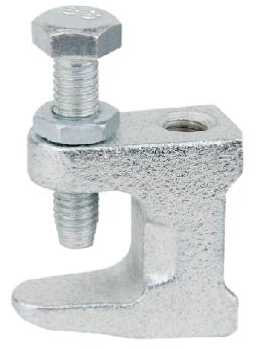
SU-MO Clamping Anchor
Clamping anchor for a fast connection between threaded rods and steel profiles — a heavy-duty beam clamp that suspends piping, cable trays and secondary structures with no drilling and no welding.
Technical specification
| Property | SU-MO — clamping anchor |
|---|---|
| Characteristics | Clamping anchor for a fast connection between threaded rods and steel profiles |
| Type | Heavy-duty mechanical beam clamp |
| Material | Steel |
| Coating | Galvanized premium steel |
| Configurations | Internal thread (SUMOM) · Clearance hole (SUMOP) |
| Thread range | M6 · M8 · M10 · M12 |
| Clearance-hole range | Ø 9 · Ø 11 · Ø 13 mm |
| Installation | No drilling · no welding · repositionable |
Downloads
ADIT SU-Mo Threaded Rod-to-Profile Clamping Anchor: Fast Structural Suspension Without Drilling or Welding
Need to suspend piping systems, cable trays, or secondary structures from steel profiles (such as IPE, HEA, HEB beams, or channels)? Traditional solutions such as drilling into thick steel or field welding demand significant resources, weaken the structural element, and damage the anti-corrosion protective coatings. The most advanced and efficient engineering solution available today is the use of the ADIT SU-Mo threaded rod-to-profile clamping anchor.
The ADIT SU-Mo system is manufactured from premium steel to strict European standards, providing a rigid, fast, and exceptionally safe connection to structural steel profiles. The anchor is designed to withstand high mechanical suspension loads and enables a direct connection of threaded rods in a clean, cost-effective, and engineer-approved manner.
How does the ADIT SU-Mo fast-clamping mechanism work?
The SU-Mo model is a heavy-duty mechanical beam clamp that works on the principle of clamping with a hardened end bolt that generates immense friction force against the profile flange. Installation is extremely simple and carried out in a few quick steps:
- Positioning the anchor: Fit the SU-Mo anchor onto the edge of the steel profile flange at the required location.
- Initial tightening: Hand-tighten the clamp’s locking bolt until it makes full, tensioned contact with the profile.
- Controlled tightening: Using a wrench, tighten the bolt according to the manufacturer’s specified torque guidelines to ensure absolute mechanical friction grip.
- Securing (locknut): Screw and fix the locknut against the clamp body to completely prevent the bolt from loosening due to vibrations.
- Connecting the threaded rod: Screw the threaded rod directly into the built-in internal thread (on SUMOM models) or pass it through the clearance hole and secure it with a nut (on SUMOP models).
Key advantages of the SU-Mo series threaded rod-to-profile clamping anchor
- Superior installation speed (Fast Fixing): Saves more than 70% of on-site labour time compared to drilling or welding.
- Zero structural damage: No need to drill holes in the structural steel (which may weaken the beam and require complex structural-engineer approvals).
- Preserves galvanizing and coating: Avoiding welding prevents destruction of the zinc layer and eliminates the need for repainting or costly fire protection during execution.
- High versatility and flexibility: The anchor can be easily adjusted, repositioned, or dismantled if the system routing changes on site, with no damage to the profile.
- High mechanical strength: Designed to carry particularly heavy suspension loads to an industrial standard.
Technical specification and available models — ADIT SU-Mo series
The anchor is available in two main configurations that provide a complete answer to every design requirement in the field: a direct internal-thread version (SUMOM) and a smooth clearance-hole version (SUMOP).
| Clearance-hole P/N | Hole diameter (mm) | Internal-thread P/N | Metric thread diameter | Material and coating | Main application |
|---|---|---|---|---|---|
| SUMOP09 | Ø 9 | SUMOM06 | M6 | Galvanized premium steel | Light suspension systems, electrical boxes |
| SUMOP11 | Ø 11 | SUMOM08 | M8 | Galvanized premium steel | Cable trays, light fire-fighting piping |
| SUMOP13 | Ø 13 | SUMOM10 | M10 | Galvanized premium steel | Sprinkler piping, air-conditioning ducts |
| – | – | SUMOM12 | M12 | Galvanized premium steel | Heavy industrial piping, secondary structures |
Frequently asked questions
What exactly is a threaded rod-to-profile clamping anchor, and when would we prefer it?
What is the practical difference between the SUMOM and SUMOP series in the ADIT SU-Mo anchors?
How does the SU-Mo clamping anchor prevent the rod from loosening due to vibrations from air-conditioning or plumbing systems?
Does using a profile clamping anchor require special approvals from a structural engineer?
What are the most common applications of the threaded rod-to-profile clamping anchor?
Can the SU-Mo anchor be installed on any thickness of steel profile?
Planning a suspension or piping system? Tell us the profile type, rod diameter and load — our engineers will help you select the right SU-MO model and send you the technical data.