

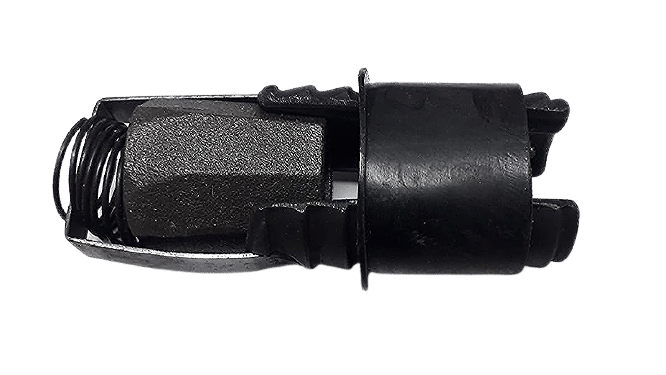
MES — Metal Expanding Shell Anchor for Dywidag
Female steel expanding anchor (Metal Expanding Shell) for a 15 mm Dywidag bar in single-sided formwork — the strongest and most documented “rock anchor” tested in the Israeli market, holding 14 tons in a real on-site pull-out test on a B40 concrete pile.
Technical specification
Female expanding anchor for Dywidag — carbon steel, for cracked and non-cracked concrete.
| Parameter | ADIT MES anchor |
|---|---|
| Anchor type | Female expanding anchor for Dywidag (Metal Expanding Shell) |
| Compatible Dywidag bar diameter | 15 mm |
| Material / steel type | Carbon steel |
| Field-test capacity | 14 tons in a pile with B40 concrete (tested between 14 and 15 tons) |
| Concrete | Cracked and non-cracked concrete |
| Drill diameter in concrete | 32–34 mm |
| Recommended embedment depth | 200 mm (150 mm beyond the rebar) |
| Recommended edge distance | 150 mm (minimum) |
| Recommended spacing between anchors | 250 mm (minimum) |
| On-site pull-out test | Recommended for project-specific capacity |
Downloads
On-site pull-out test videos
MES anchor pull-out test up to 14 tons.
ADIT MES rock anchor for Dywidag — the complete guide
Every contractor and subcontractor who has worked with single-sided formwork in piles knows this small accessory, popularly called a “rock anchor” — and by its engineering name, a female expanding anchor for Dywidag (Metal Expanding Shell). The anchor is threaded onto a Dywidag bar, inserted into a hole drilled in the concrete, and once the worker tightens it, it “opens” and locks itself inside the concrete — so the Dywidag bar can be removed from the outer side after casting and bolts connected to it later in the work.
The problem: most rock anchors sold on the market are marketed without an official technical specification and without a substantiated pull-out test. The ADIT MES anchor is a notable exception in the field — it is an anchor for Dywidag that underwent a documented on-site pull-out test, on a real pile in B40 concrete, and held a pull-out load of 14 tons. This is compared with generic rock anchors that, in a similar field test, held only about 5.4 tons — less than half the load the importer declared.
What is a rock anchor and why is it used to connect Dywidag
A rock anchor is a popular name for a female steel expanding anchor (Metal Expanding Shell) used to connect a Dywidag bar (a fully threaded bar) to concrete when working with single-sided formwork — for example when casting piles, retaining walls or diaphragm walls where the Dywidag bar cannot be connected from both sides. The anchor is threaded onto the end of the Dywidag bar, inserted into a hole drilled in the concrete, and after tightening it “opens” mechanically and physically locks itself inside the concrete. This allows the external side of the Dywidag bar to be removed at the end of the work, and bolts, additional formwork or other elements connected in its place.
The MES anchor (Metal Expanding Shell) by ADIT is exactly this type of anchor: a female anchor for Dywidag with a 15 mm diameter, made of carbon steel, with expanding wings and a retaining strap that prevents the anchor from rotating together with the bar during threading.
Generic rock anchor vs. ADIT MES — what is the difference in actual capacity?
In most cases, importers and distributors of rock anchors declare an allowable load and a failure load “on paper” — but this figure does not always reflect what happens in the field, on real concrete and under real installation conditions. In a pull-out test carried out on site for one of the largest contractors in Israel, a generic rock anchor 16 mm in diameter — declared to have an allowable load of 9 tons and a failure capacity of about 14 tons — actually held only 5.4 tons. In contrast, under the same test conditions, the ADIT MES anchor actually held 14 tons — 2.5 times more.
| Parameter | Generic rock anchor (unbranded) | ADIT MES anchor |
|---|---|---|
| Declared capacity (manufacturer) | Up to 9 tons allowable / ~14 tons failure | — |
| Capacity in on-site pull-out test | 5.4 tons | 14 tons |
| Official technical specification | Missing in most cases | Available — see technical specification above |
| Documented pull-out test | Usually not actually performed | Performed and documented (pile, B40 concrete) |
The practical conclusion: a “rock anchor” is not a uniform product — there are large gaps in capacity between suppliers, and not every anchor presented as an “anchor for Dywidag” truly meets the load declared for it. Before purchasing a rock anchor, check the product’s source, demand real pull-out test data, and in many cases — perform a dedicated pull-out test at the work site.
Installation guide — ADIT MES anchor step by step
Correct installation is the decisive factor in the actual capacity of a rock anchor — a significant portion of cases where an anchor “does not hold” as it should stem from incorrect installation rather than a defect in the product itself. Follow these installation steps exactly:
- Drill and clean the hole — drill a hole 32 to 34 mm in diameter and 200 mm deep (150 mm beyond the reinforcement bar), and clean the borehole thoroughly with compressed air (compressor/pump) to remove drilling dust.
- Remove the plastic sleeve — remove the protective plastic sleeve covering the MES anchor body, exposing the wings and the retaining strap.
- Thread the Dywidag bar into the anchor — manually thread the Dywidag bar into the MES female anchor up to its end, ensuring a full, straight thread.
- Check the wing orientation and insert into the hole — make sure the retaining strap and the wings face one another and not toward the concrete edge. Hold all anchor parts in one hand and insert it, attached to the Dywidag bar, to the bottom of the borehole (a cone can be added if needed).
- Final threading and tightening — tighten the Dywidag bar with a wrench, or by closing a wing nut. Prevent the MES anchor from rotating together with the bar — this is the most common installation mistake, causing partial opening of the anchor and lower-than-expected capacity.
- Casting and removing the Dywidag bar — after the concrete is cast and hardened, the external end of the Dywidag bar can be removed using an open-end wrench, or by preventing rotation with a wing nut, together with the MES anchor fixed in the concrete.
What to do (recommended)
- Drill to the exact depth and diameter specified (32–34 mm, 200 mm).
- Clean the borehole thoroughly of drilling dust before threading the anchor.
- Make sure the wings and the retaining strap face one another.
- Prevent the anchor from rotating during final tightening of the bar.
- Keep minimum distances from the concrete edge (150 mm) and between anchors (250 mm).
- Perform an on-site pull-out test when capacity is critical to the project.
- Choose a documented MES anchor, not a rock anchor without test data.
What not to do
- Allow the anchor to rotate together with the Dywidag bar during threading.
- Install at a drilling depth shallower than recommended (200 mm).
- Ignore cleaning the drilling dust from the hole.
- Install closer than 150 mm from the concrete edge.
- Assume every “rock anchor” on the market holds the same capacity.
- Rely on declared capacity without an on-site pull-out test in sensitive cases.
- Use a damaged or deformed anchor, or one whose wings do not open smoothly.
Common applications for the ADIT MES rock anchor
- Piles with single-sided formwork — the classic use: connecting a Dywidag bar to single-sided formwork on a pile, when the other side of the concrete cannot be accessed.
- Retaining walls and diaphragm walls — connecting formwork to retaining and diaphragm walls during casting, when the Dywidag bar must be removed at the end of the work.
- Foundations and infrastructure structures — temporary anchoring points for formwork in foundations and infrastructure structures, requiring convenient removal of the Dywidag bar after the concrete hardens.
- Installations requiring high capacity — projects requiring high, proven pull-out capacity, not just a manufacturer’s declaration, such as suspended scaffolding and heavy temporary supports.
Engineering note: in any case where the Dywidag bar can be connected from both sides (double-sided formwork) or where removing the bar is not required — it is worth also considering a chemical anchoring alternative, which provides higher and more consistent capacity independent of the quality of the anchor’s mechanical installation. For any doubt about the right choice for your project, contact an ADIT Ltd. engineer at 054-7976110.
Frequently asked questions
What is a rock anchor and why is it called that?
What is the difference between a rock anchor and a chemical anchor for connecting Dywidag?
What is the actual capacity of the MES rock anchor?
Why do different rock anchors hold such different capacities?
What is an anchor for Dywidag and why is it needed in piles?
What drill diameter and depth are required to install the MES anchor?
What is the minimum distance required from the concrete edge and between adjacent rock anchors?
What is the most common mistake in installing a rock anchor?
Should an on-site pull-out test be performed for a rock anchor?
What Dywidag bar diameter fits the ADIT MES anchor?
Can a rock anchor be used in concrete of a strength other than B40?
Which costs more in the end — a rock anchor or chemical anchoring?
Why is ADIT MES considered the best rock anchor in Israel?
Working with single-sided formwork or need a proven rock anchor for Dywidag? Tell us the concrete type, bar diameter and load — our engineers will advise on the MES anchor and the recommended on-site pull-out test.