


How anchors behave under blast loading
12 בJuly 2026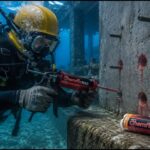
Underwater (chemical) anchoring: how to design it and how to install it
12 בJuly 2026How anchors behave under blast loading
12 בJuly 2026Underwater (chemical) anchoring: how to design it and how to install it
12 בJuly 2026Why Use a Bad Plug When You Can Use a Good One?
Choosing the wrong anchoring element is one of the most common causes of structural failure, property damage and even danger to life — and, in most cases, the right plug costs almost the same as the wrong one.
Whether the job is a light domestic fixing or an industrial structural system, there are hundreds of anchors and plugs on the market. Matching them precisely to the base material, the type of load and the relevant standards is a basic condition of professional work.
The cheap-plastic trap vs the nylon anchor (PA6)
In most builders’ merchants in Israel, cheap plastic plugs sell by the hundred thousand — and their load-bearing capacity is significantly lower than most people assume. The professional alternative costs about the same but performs on an entirely different level: the nylon anchor, made from polyamide PA6.
Most of those cheap plugs are moulded from low-grade recycled polyethylene, and they are fit only for light domestic work — hanging a small picture, or a very light fixing. Most of us have already seen one fail and pull straight out of the wall in an application no heavier than a shower tap. For shelves, cabinets or anything with real weight on it, the simple plastic plug is not a safe answer.
Professional anchoring suppliers avoid stocking them for two main reasons. First, ordinary plastic dries out, breaks down and loses its properties over the years. Second, its load capacity is far lower than that of a proper nylon anchor — for a price difference that is almost nothing.
What are the technical differences between a plastic plug and a professional nylon anchor?
| Cheap plastic plug | Nylon anchor (PA6) | |
|---|---|---|
| Material | Brittle, low-grade plastic | Polyamide PA6 |
| Durability | Dries out and degrades | Holds its properties for 50+ years |
| When bent by hand | Cracks and snaps | Bends without breaking |
| Pull-out capacity | Baseline | 2 to 4 times higher |
| Price | Cheap | Similar — the difference is negligible |
A quality PA6 anchor retains its mechanical properties, does not dry out, and holds its position in the base material for more than 50 years without significant loss of performance. It is far more flexible and far stronger than the brittle plastic plug, and it carries pull-out loads two to four times higher — all for a price difference that is trivial set against the damage a failure would cause.
How to tell a professional anchor from a cheap plug
- Buy from licensed suppliers. Go to companies that work exclusively in anchoring and fixing engineering — Adit, Hilti, Fischer and the like — rather than to a general hardware counter.
- Look for an ETA. Every anchor carrying a European Technical Assessment has been laboratory-assessed for a working life of at least 50 years, which rules out the simple plastic plug straight away — do not settle for a general claim from the manufacturer.
- Confirm the material. Ask to see that the anchor is made from polyamide PA6.
- Test the elasticity on site. A quality PA6 nylon anchor bends easily without breaking; it will never crack or snap when bent by hand.
The minimum for a safe specification
Before you choose an anchoring element for your next project, make sure you can answer three questions:
- What exactly is the base material? Cracked concrete, hollow block, Ytong block, or a prestressed hollow-core slab.
- Does the product hold a relevant ETA approval? Do not settle for general claims.
- What is it made of? Prefer polyamide PA6 nylon anchors, or pure epoxy systems for structural applications.
The range, from the cheapest to the one that belongs on a specification
The plain plastic plug
Low-grade recycled polyethylene, no approval, no declared load. Fine for a picture hook in solid plaster and nothing beyond that.
TN4S
Universal PA6 nylon anchor with four-direction expansion — Adit’s strongest and most advanced plug for heavy loads, plasterboard included. The same anchor works in concrete, solid and perforated brick, hollow block, aerated (Ytong) block, stone and gypsum board, which makes it the choice when you do not know what is behind the wall. Available in 8 and 10 mm. In Israeli hollow block, our own on-site pull-out tests take the 8 mm to roughly 80 kg and the 10 mm to roughly 150 kg. Those are ultimate failure loads measured in the field, not working loads, and they sit above the figures in the European datasheet — which are maximum recommended loads (Nrec) established on European block, a different and weaker product.
GL
General-purpose PA6 nylon anchor for solid substrates — concrete, solid brick and stone — where the fixing is light to medium and the hole is short.
GX-L
Long universal PA6 anchor that expands in three directions and works in concrete, hollow block and aerated block alike. About 200 kg in 8 mm and 400 kg in 10 mm in sound concrete, and the anchor we would put on a specification when the substrate is not certain.