

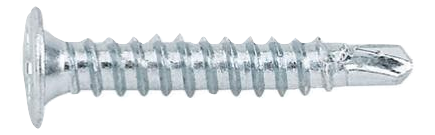
BCP Extra-Flat Head Self-Drilling Screw
Extra-flat head self-drilling screw with an integrated drill point — pierces and threads steel and aluminium profiles in a single action, with a low Phillips-drive head that does not protrude above the surface.
What is the BCP extra-flat head self-drilling screw?
The BCP extra-flat head self-drilling screw is a unique self-drilling screw with an especially low, extra-flat head and a Phillips (Ph) drive, designed for connections that require a low-profile head that does not protrude above the surface. The screw incorporates a drill point at its tip, allowing it to pierce the profile and thread in a single action – with no pre-drilling.
The BCP extra-flat head self-drilling screw is especially suited for fastening steel and aluminum profiles up to 4.4 mm thick (steel version) or up to 2.0 mm thick (A2 stainless steel version), and is used for sliding doors, windows, mortise locks, and any application requiring a thin, aesthetic, low-head connection.
When do you use the BCP extra-flat head self-drilling screw? Typical applications include: assembling metal frames, connecting aluminum profiles, installing cladding and panels, manufacturing metal furniture, and anywhere a protruding head could snag the side or catch on moving parts.
The advantages of the BCP self-drilling screw – not every self-drilling screw is the same
- Extra-flat head: a low, radius-rounded head that slides and does not catch on moving parts – ideal for sliding doors, windows, and locks.
- Approved technical data: precise pull-out and shear values for every profile thickness, enabling safe and documented engineering design.
- Direct-threading technology: the screw drills and threads in a single action – no pre-piercing, no additional accessories.
- Available in a range of versions: steel with cold galvanizing (BCPZ, BCPB, BCPN, BCPZ BL) and A2 stainless steel for humid and aggressive environments (BCP A2).
- Engineering support and warranty: ADIT engineers are available to help select the right model, calculate loads, and meet technical specifications.
Approved technical data – loads for steel profiles
The following data forms the basis for safe structural design. All values in the tables are in kN per single screw. Note: the shear capacity does not account for tear-out of the profile itself (steel or aluminum). The designer must verify the profile’s tear-out capacity in order to determine the final shear value.
ST 4.2 – connection to a steel profile
| Load Parameter (kN) | Steel Thickness 2 mm | Steel Thickness 2.5 mm | Steel Thickness 3 mm |
|---|---|---|---|
| Characteristic Failure Load – Pull-Out (Nrk) | 4.6 | 5.0 | 5.3 |
| Characteristic Failure Load – Shear (Vrk) | 2.6 | 2.6 | 2.6 |
| Design Load – Pull-Out (Nrd) | 2.1 | 2.3 | 3.7 |
| Design Load – Shear (Vrd) | 2.0 | 2.0 | 2.0 |
| Recommended Load – Pull-Out (Nrec) | 1.5 | 1.6 | 2.6 |
| Service Load – Shear (Vrec) | 1.4 | 1.4 | 1.4 |
Geometry and dimensions
The BCP extra-flat head self-drilling screw is available in diameter ST 4.2, in two standard lengths suited to most drilling applications in steel and aluminum profiles:
| Parameter | Value |
|---|---|
| Screw Diameter (dk) | ST 4.2 |
| Head Diameter (dk) | 8 mm |
| Head Thickness (K) | 0.7 mm |
| Bit | PH 2 |
| Outer Diameter incl. Thread (D) | 4.2 mm |
| Screw Core Diameter (d) | 3.1 mm |
| Pitch (P) | 1.4 mm |
| Drill Point Length (Z) | 4 mm |
| Available Lengths (L) | 14 mm, 23 mm |
| Maximum Drillable Steel Thickness | 0.7 – 2.0 mm (BCP A2) / up to 4.4 mm (BCP steel) |
Maximum recommended fastened steel thickness by screw length (ST 4.2)
| Screw Length (mm) | Maximum Fastened Steel Thickness (mm) |
|---|---|
| 9.5 | – |
| 13 | 4.3 |
| 16 | 0.3 |
| 19 | 10.3 |
| 22 | 13.3 |
Models, part numbers and versions
The BCP series is available in a range of coatings and materials, allowing you to select the extra-flat head self-drilling screw suited to every environment and application:
| Model | Coating / Material | P/N 4.2×14 | P/N 4.2×23 | Units per Box |
|---|---|---|---|---|
| BCPZ | Cold Galvanized (Zinc) | BCPZ4214 | BCPZ4223 | 500 |
| BCPB | White Galvanized | BCPB4214 | BCPB4223 | 500 |
| BCPN | Black Galvanized | BCPN4214 | BCPN4223 | 500 |
| BCPZ BL | White Head Only, Galvanized Body | BCPZ4214BL | BCPZ4223BL | 500 |
| BCP A2 | A2 Stainless Steel (SS304) – Passivated | BCPA24214 | BCPA24223 | 500 |
Important note for the BCP A2 (stainless steel) version: this screw is intended for use with aluminum only and is not designed to drill steel – the drill point will burn out due to the lower hardness of the stainless steel. To drill steel in a corrosive environment, use the bi-metal BIE models.
Quick installation guide
- Mark the drilling point: a light tap with a center punch for accurate centering will prevent the drill point of the extra-flat head self-drilling screw from slipping at the start of rotation.
- Prepare the right driver: use an impact driver. Recommended speed: in steel 1000–1800 rpm, in stainless steel 600–1000 rpm. Exceeding the speed causes the drill point to burn out.
- Drive perpendicular to the profile: hold the driver at 90 degrees to the material with even pressure. Driving at an angle breaks the drill point and produces a defective connection.
- Stop when the screw head seats: when the head of the self-drilling screw seats against the profile – stop. Over-driving will strip the thread and weaken the connection.
Suitable driver specifications
| Anchor Type | Material | Drilling Speed (rpm) |
|---|---|---|
| ST 4.2 (BCP steel) | Steel | 1000 – 1800 |
| ST 4.2 (BCP A2 stainless) | Stainless / Aluminum | 600 – 1000 |
Frequently asked questions
What is the difference between the BCP extra-flat head self-drilling screw and a standard self-drilling screw (ABE)?
What is the difference between the BCPZ, BCPB, BCPN, and BCPZ BL models?
When must I use BCP A2 (stainless steel) instead of BCP steel?
Can the BCP A2 be used to drill steel?
What is the maximum profile thickness that the BCP extra-flat head self-drilling screw can drill?
Why does the screw’s drill point break?
What is the difference between failure load (Nrk), design load (Nrd), and recommended load (Nrec)?
What happens if I over-tighten the BCP extra-flat head self-drilling screw?
Fastening steel or aluminium profiles? Tell us the profile thickness, material and load – our engineers will select the right BCP model and send you the approved pull-out and shear data.