



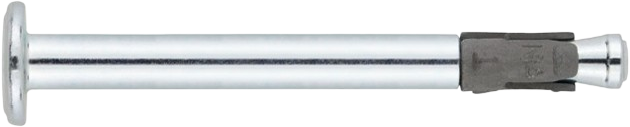
NA Hammer-In Wedge Anchor
Hammer-in wedge anchor with the European ETA1 approval – in a range of heads, including a hook head for anti-pigeon netting.
A Hammer-In Wedge Anchor, in a Range of Heads
The NA is a wedge anchor set with a hammer, carrying the European ETA1 approval for cracked and uncracked concrete and an F120 fire approval.
NA-C
Standard head – for general anchoring into concrete.
NA-G
Hook head – the solution for anchoring anti-pigeon netting and for suspension.
NA-R
Eye head – for attaching a carabiner, shackle or cable.
Technical Specification
| Characteristics | Hammer-in wedge anchor |
| Technology | Wedge anchor |
| Cracked concrete | Yes |
| Fire standard | Yes – F120 |
| Heads | NA-C (standard) · NA-G (hook) · NA-R (eye) |
| Approvals | European ETA1 for cracked and uncracked concrete |
Files to Download
Frequently Asked Questions
Which head should I choose?
NA-C for general anchoring. NA-G (hook head) for anti-pigeon netting and suspension. NA-R (eye head) for attaching a carabiner, shackle or wire.
What is the difference between the NA and the AN-CU?
Both are hammer-set anchors with ETA1. The AN-CU is a nail anchor with a flush head – fast for volume work. The NA is a wedge anchor, available in a range of heads including hook and eye.
Is it suitable for working at height?
No. The NA-R is not approved for working at height. Anchor points for rope access and fall protection require an anchor approved to EN795 – see the BTEYE2 or the AAC.
Wedge anchor in the NA-Chanking – The Solution to anchoring Network Against Union
When it comes to protecting structures from other ions and pests, anchoring to the network against the United Nations It’s no less important than the network itself. Wedge anchor in NA The Index is the fast, reliable and European happiness solution to the decline of anti-ionone networks to concrete walls – without screws, without the barge, without the need for developers.
The NA anchor is Wedge anchor by Nail Anchor mechanical anchor, which enters the hole, is drilled in concrete and is determined by a controlled spread in a hammer-floor. It is made of carbon steel from a glory and comes in5 different heads The tailored to different apps – including head of Wi-G, specifically designed for network suspension and anchoring stretch wires. All versions come in the Ø6 diameter from “appiness to European Technical Assessment ETA 24/0011.”
What distinguishes the NA anchor: Installation within seconds without the key of the burglar, is approved for Cracked concrete and La-No-Sedek, the depth of drilling of only 6 mm, and resistance over 50 years in foreign conditions – the fastest and reliable solution to the decline of the ions network in the concrete Wall.
The NA anchor – what is the difference between the models?
The NA anchor comes in five different head versions, with all sharing the same organ Ø6 mm, the same installation principle in the fabric, and the same level of approved performance. The choice between versions depends on the type of connection required to the network or the anchoring derivative.
NA-C The flat head.
A flat head (Flat-head strike) is suitable for direct fixation of the anchoring tablet, metal frame, or other flat accessories. It can be used with a separate hook to the anchoring network.
NA-E Head of the M6
anchored with the M6 Barghre wire (Studded molly bolt) enables a connection of a nation and various accessories directly to the head of the anchor after installation. Maximum flexibility.
NA-F Head of M8/M10
Head with an additional seal (Hooked molly bolt) to M8 or M10 controls – suitable for linking profiles and heavier network frameworks.
NA-G ⁇ – to the network of ions
The preferred version of anchoring network against Union. Head Wi (Hook) that enables the transfer of a stretch wire (Nastata or PVC coating) directly through the Hou – the fastest and convenient installation for anti-ion networks.
NA-R Head of the Check
Eyebolt embedded – enables a ring connection to the tyre and stretch systems. It is suitable for a regular anchoring of horizontal wires.
Adit recommendation to the network of June: Most project will anchoring an anti-ionine network on Wall concrete – use the Q002NA-G (head). . . Hou allows to pass the hyrosta wire directly, fast and reliable, without the train additional accessories.
European Technical Assessment ETA 24/0011 – What does it mean for you?
The NA anchor holdsapproval Technical ETA 24/0011 May 6, 2025 by the IET (Instituto de Ciencias de la Construcción Eduardo Torroja) – a recognized technical evaluation body of the European Union. This is the highest possible recommendation for this kind of anchor, allowing it to be used in all EU countries and abroad.
- Product: NA Nail Anchor – Wedge anchor to concrete, diameter 6 mm, carbon steel from glory
- defined use: Non-Structural Systems (Redundant Non-Structural Systems) systems – including anchoring Networks, Sclays, Anti-None
- concrete is happy: concrete is armed and non-fluential, C20/25 to C50/60 (in 20 to 50 in Israeli marking), cracked and unsed)
- Happy loads: static and cosazical loads
- The temperature of work: minus 40°C up to 80°C
- Life length: 50 years in normal use
- The AVCP system: 2+ (authorised third party)
- Response to the Fire: Class A1 by EN 13501-1 – No-Delek
Technical data – Installation and resistance
All the following data are based on ETA 24/0011 About the Technical data FT NA-es rev.0. The NA-G anchor (the version of the Union Network) is unique to resistance as a typical failure of 1.5 kN In every direction, it is as…150 kg A single anchor – resistance is much higher than the required anchoring network.
| The model | Description of the Head | The depth of the h1 (m) | F0Rk (kN) | The F0Rd (kN) | Recommended F0rec (kN) |
|---|---|---|---|---|---|
| NA-C | The flat head. | 35 / 40 | 3.0 / 5.0 | 1.67 / 3.33 | 1.19 / 2.38 |
| NA-E | The M6 | 35 / 40 | 3.0 / 5.0 | 1.67 / 3.33 | 1.19 / 2.38 |
| NA-F | The M8/M10 | 35 / 40 | 3.0 / 5.0 | 1.67 / 3.33 | 1.19 / 2.38 |
| NA-G ⭐ | ⁇ – to the network of ions | 35 / 40 | 1.5 / 1.5 | 0.83 / 1.00 | 0.60 / 0.71 |
| NA-R | Head of the Check | 35 / 40 | 1.5 / 1.5 | 0.83 / 1.00 | 0.60 / 0.71 |
| 1 kN ⁇ 100 kg | Data for a single anchor without end-to-end distance effects | Source: ETA 24/0011 Annex C3 | |||||
| Parameter | Sergeant | Standard depth | reduced depth |
|---|---|---|---|
| Drill hole diameter | d₀ | 6 mm | 6 mm |
| The depth of drilling | h₁ | 40 mm | 35 mm |
| embedment depth Numinily | hnom | 35 mm | 30 mm |
| Effective depth of penetration | hef | 30 mm | 25 mm |
| Minimum concrete thickness | hmin | 80 mm | 80 mm |
| Minimum distance from end | cmin | 35 mm | 35 mm |
| Critical distance (cous) | ccr | 65 mm | 50 mm |
| Minimum distance between anchors | smin | 35 mm | 35 mm |
installation guide – Wedge anchor in NA-G Printing to the Unimaginated Network
One of the biggest Advantages of Wedge anchor in the Dupico It is the installation simplicity. There is no need for the barge key, no contagious substances are needed, and no special tools are needed except drill bit and hammer. Here are the three stages:
Please note: After a failed quarry (wrongly) a new hole should be drilled at least 2 times from the failed hole, or filling the eccentric hole with a high strength promise before using.
- Follow the concrete to be cut, armed, or not-spoken.
- Use the drill bit diameter 6 mm.
- Clean the hole before each installation.
- Save at least 35 mm from the concrete
- Use NA-G for stretching tariffs to the UNICEF network.
- Work with competent human power.
- Do not install a pana, hollow block is hollow or stone.
- No depth is less than 35 mm.
- Do not use a failed anchor and return to the same hole.
- Do not install a small distance from 35 mm from the end of the console
- Do not damage the glycoone coating during installation
- Do not use as a primary constructor anchor.
Applications – Where do we use the NA anchor to the Unim network?
anchoring to the network against the United Nations It is carried out at height, on external walls, under bridges, in the shafts and balconies – wherever other pigeons and birds find shelter. The NA anchor is suitable for all the common situations:
⁇ residential buildings
A network of anti-ion to the fronts of concrete building – balconies, pages, between floors and panels. NA-G allows a quick connection of the hyrosta wire to a single area.
Industrial and Commercial Building
warehouses, factories, markets and logistics centers – large chains require anchors in large quantities. The NA anchor allows a high-installation rate and a low price to the anchoring point.
Bridges and infrastructure
concrete, support pillars and infrastructure buildings – which attaches permission under the bridges and shafts. The wet conditions justify the use of the spraying coating of the video ( ⁇ 40μm).
⁇ Historical buildings
The minimum rash (Na6 mm) reduces damage to the fronts. It is suitable for buildings that are kept in which they want minimal aesthetic injury.
⁇ ⁇ ⁇ ⁇ ⁇ ⁇ ⁇ ⁇ ⁇ ⁇ ⁇ ⁇ ⁇ ⁇ ⁇ ⁇ ⁇ ⁇ ⁇ ⁇ ⁇ ⁇ ⁇ ⁇ ⁇ ⁇ ⁇ ⁇ ⁇ ⁇ ⁇ ⁇ ⁇ ⁇ ⁇ ⁇ ⁇ ⁇ ⁇ ⁇ ⁇ ⁇ ⁇ ⁇ ⁇ ⁇ ⁇ ⁇ ⁇ ⁇ ⁇ ⁇ ⁇ ⁇ ⁇ ⁇ ⁇ ⁇ ⁇ ⁇ ⁇ ⁇ ⁇ ⁇ ⁇ ⁇ ⁇ ⁇ ⁇ ⁇ ⁇ ⁇ ⁇ ⁇ ⁇ ⁇ ⁇ ⁇ ⁇ ⁇ ⁇ ⁇ ⁇ ⁇ ⁇ ⁇ ⁇ ⁇ ⁇ ⁇ ⁇ ⁇ ⁇ ⁇ ⁇ ⁇ ⁇ ⁇ ⁇ ⁇ ⁇ ⁇ ⁇ ⁇ ⁇ ⁇ ⁇ ⁇ ⁇ ⁇ ⁇ ⁇ ⁇ ⁇ ⁇ ⁇ ⁇ ⁇ ⁇ ⁇ ⁇ ⁇ ⁇ ⁇ ⁇ ⁇ ⁇ ⁇ ⁇ ⁇ ⁇ ⁇ ⁇ ⁇ ⁇ ⁇ ⁇ ⁇ ⁇ ⁇ ⁇ ⁇ ⁇ ⁇ ⁇ ⁇ ⁇ ⁇ ⁇ ⁇ ⁇ ⁇ ⁇ ⁇ ⁇ ⁇ ⁇ ⁇ ⁇ ⁇ ⁇ ⁇ ⁇ ⁇ ⁇ ⁇ ⁇ ⁇ ⁇ ⁇ ⁇ ⁇ ⁇ ⁇ ⁇ ⁇ ⁇ ⁇ ⁇ ⁇ ⁇ ⁇ ⁇ ⁇ ⁇ ⁇ ⁇ ⁇ ⁇ ⁇ ⁇ ⁇ ⁇ ⁇ ⁇ ⁇ ⁇ ⁇ ⁇ ⁇
concrete ceilings, beams and columns in roof and ground parking – a ion net prevents quinone and a clean shift.
⁇ Any anti-figuon application
Everywhere installed on a mansruta or PVC network against pigeons/birds on concrete is the right, fast and happy solution.
| McT | description | The diameter (d0) | Total length (L) | The depth of the drilling (h1) | The thickness of the duct (tfix) |
|---|---|---|---|---|---|
| NAG6055 | NA-G M6×55 – Head of Wei | 6 mm | 55 mm | 30 to 35 mm | 20-25 mm |
CE is happy
Head of Wie to the Stretch
Ø6 mm – Minimum drilling
Cracked concrete and Non-Society
50 years of resistance
Materials and resistance – All about the glycoone coating
The NA anchor is built fromCarbon steel from the holoon In a different process for each part:
- The Body of the Organ: Carbon steel, electrolyte gallon ⁇ 5 μm according to ISO 4042 Zn5
- The video (clip): Carbon steel, Schherardizing ⁇ 40 μm according to EN 13811 – the most durable coating in the series
- Wade, nation, and the same thing: Electrolyte ⁇ 5 μm according to ISO 4042 Zn5
project will anchoring a unicorn network near the sea coast, or in a humid environment, additional solutions can be considered – turn to Adit engineers for specific counseling.
Common Questions – Wedge anchor in Daffi and anchoring to the Unioned Network
Wedge anchor in the Dupico (Nail Anchor) is mechanical anchor in the midst of a drilling hole and is determined by controlled expansion. Unlike a normal screw that enters the screw, Wedge anchor is knocked on the hole in the hammer – a clip that places around the anchor body spreading into the concrete lines and creates a strong mechanical connection.
The NA anchor works in method Deformation-Controlled Expansion – The expansion is controlled and accurate, allowing consistent and reliable performance in all drilling. There are no contagious materials, no apocalyses coating, and no need for a period of sleep.
NA-G (head of W): A semi-opened Hou enables a simple and quick transfer of a stretch wire (Nastata) directly through the hook without tools. Best suited for anti-ionine networks with stretch wires – the installation is at least 2 times faster than alternatives.
NA-R (head of the spring): Closed overview that allows connection with the tyrant, tycoon or wire after installing the anchor. Less fast to stretch latency, but more suitable for the anchoring fixed points and stretch systems of horizontal wires.
Most often project will be a network of finished ions. NA-G is better. . . anchoring One point with the veterinarian – weighed NA-R.
The quantity depends on the size of the network and the recommended distances. Standard application for the network of ions:
- Distance between anchors: usually 30-50 cm Along the line of the sway (depending on the wind load and the specification of the network supplier)
- Areas of 10 sq.m. – average 20-30 anchors
- For a full building front, a detailed calculation must be made according to the front.
Make sure the Adit engineer calculates a precise amount to your project.
Yes! yes! anchored by NA Happy to use Cracked concrete and Unchecked According to ETA 24/0011. The technical data on the ETA card refers to both concrete modes and consistent performance.
The minimum concrete required is C20/25 (B-20 in Israeli marking). In concrete, it is weaker, or in concrete, which is marked by severe shortcomings – consult an engineer before making.
According to ETA 24/0011, for NA-G in standard depth installation (hef = 30 mm) in concrete C20/25–C50/60:
- Typical failure (F0Rk): 1.5 kN ⁇ 150 kg
- The load (F0Rd): 1.0 kN ⁇ 100kg
- Recommended for normal use (F0rec): 0.71 kN ⁇ 71 kg
For a normal ions network, which mainly operates in wind loads, the anchor is much stronger than necessary. The power required for a standard ion network to wind is usually 5-20 kg per point. Far from the boundaries of the NA anchor.
The NA anchor is designed forNon-Constructive Systems Will Be Resolved (Redundant Non-Structural Systems) – a category in which, if one anchor fails, the load goes to nearby defenders without damage to the structure.
According to ETA 24/0011, the design is required to be carried out under the responsibility of an experienced engineer in anchoring and concrete. For projects commercial and infrastructures, it is very recommended to involve an engineer. For anchoring, my home is simple on the UNICEF network – turn to Adit for advice.
Two types of mechanical anchors, but the method of different biosus:
- The anchor in Nail Anchor/Na: Enter the hole directly in the hammer. The spreads are built in the video. Fastest, without special tools. It is suitable for light to medium loads.
- mechanical anchor (Expansion Anchor) Enter the hole and the market by the barge with a key. It allows higher loads and anchoring constituencies. It is suitable for apps with big loads.
The Universal Network – anchor in the NA fabric is the right solution for performance and price.
The installation rate of the NA anchor is one of the most important in the market:
- The SAS (with drill bit SDS): 15-30 seconds to get off.
- Cleaning: 10 to 15 seconds
- The plaque and anchoring: 5-10 seconds.
About 30 to 60 seconds to anchor. An experienced team can install 50–80 anchors in one working time – making projects large for economic and fast.
Yes, the NA anchor was designed for foreign conditions:
- The Video The cylinder ⁇ 40μm method according to EN 13811 – the coating considered most resistant to foreign conditions
- The other components. Electrolyte ⁇ 5μm according to ISO 4042 Zn5
- Life span is defined in the device: 50 years Ordinary use conditions
For a near marine environment (up to 1km) – it is recommended to consider stainless alternatives. Go to the Adit engineers.
All NA anchor versions (C, E, F, G, R) require A uniform quaint of 6 mm. . . This is a significant advantage – the work team should not replace drill bits among different types of anchors.
Use the head of drill bit SDS-Plus in diameter 6 mm with the head of the plaque. Make sure that the drill bit is in the EN ISO 5468 standard for uniform performance.
The NA anchor is a permanent anchor. After a smack, the video spreads into the concrete and cannot be removed without damage to the surrounding concrete. If required to remove an anchor:
- The head of the anchor can be cut and grind the bees.
- Alternatively, you can drill around the anchor and take it with the surrounding concrete.
- After the removal, the hole must be suffocated before reinstalling.
Unlike the NA anchor, the MTP anchor can be removed in the backward screw.
The two types of networks that are common to anchoring on concrete:
- The Stainless Steel Net: Stretch wires and a network from the Moscow 316L. resistance is a high price. It is designed for long-term projects. Connecting to NA-G through the hook directly with the stainless wire.
- Polyethylene (PE/HDPE): A light grid with belts. Easy to install, low price. It is designed for short-term use. You can connect through NA-G with tough PVC wires.
NA-G is suitable for two types of networks. The difference is in the sip of the snoring used to connect the network to the anchor.
ETA – European Technical Assessment It is a European technical approval that is provided by EU 30/2011. It is:
- approval is official on product performance under defined usage conditions
- A basis for CE that enables marketing and use in all EU countries
- A technical document that defines the approved use, performance limits and installation requirements
- The guarantee that the product was tested by an independent certified body
For project, the ETA 24/0011 network of the NA anchor provides the legal and technical solution to include the anchor in engineering specifications and approval sea to project.
According to ETA 24/0011, the minimum distance between nearby anchors is 35 mm When the distance is at least 50 mm. In the projects of the Unim network, the actual distance between the anchors is usually 30–60 cm Throughout the stretching lines, depending on the design of the network and the wind loads.
There is no maximum distance required – it is determined according to the requirements of the network specification. Please call Adit to help design.